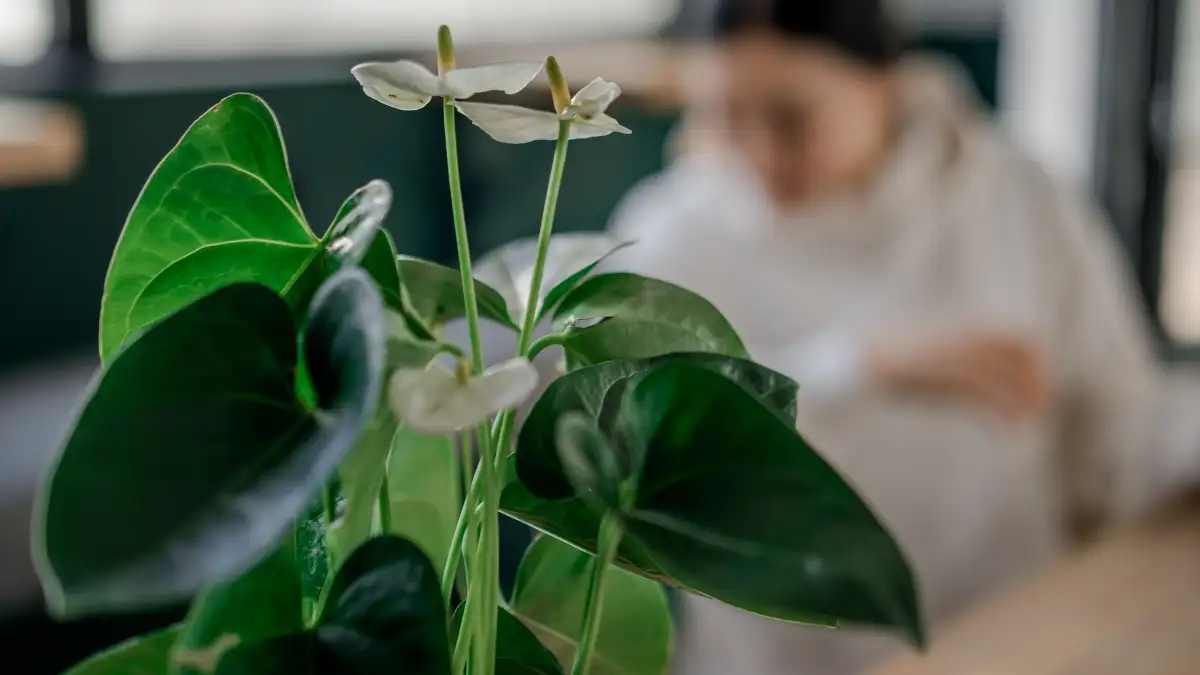
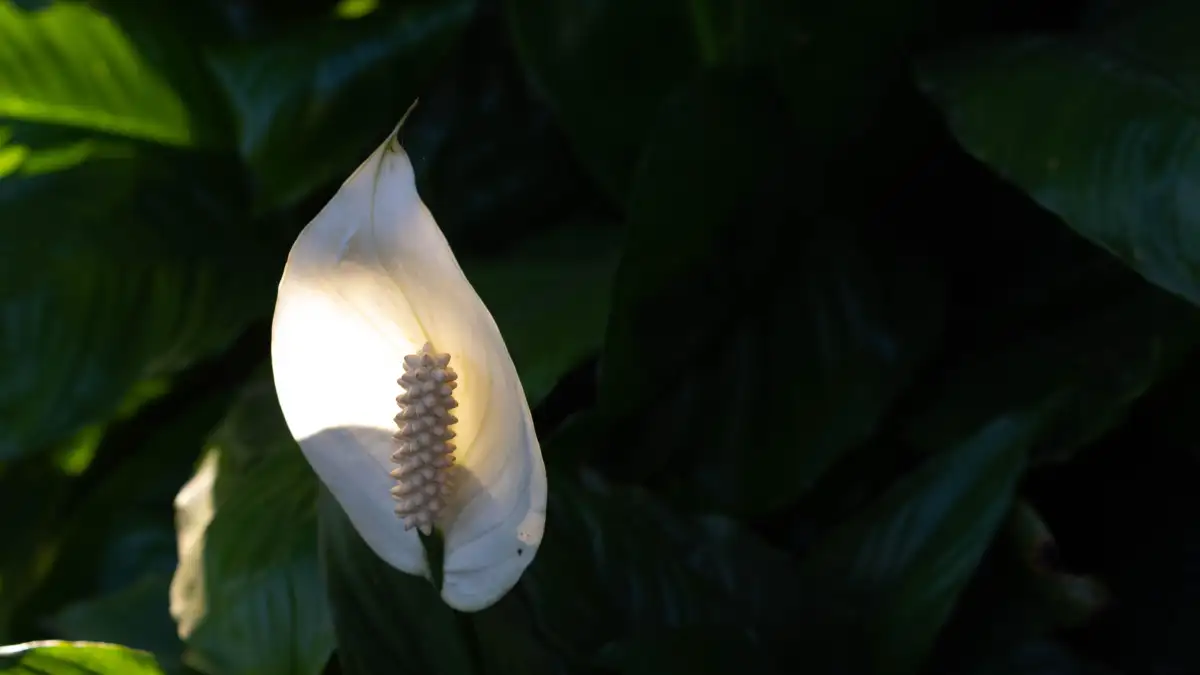
The brown tips on a peace lily watered with tap water are almost never caused by the chlorine you can smell. They come from what the water leaves behind: fluoride and dissolved mineral salts that ride the transpiration stream to the leaf tips and stay there, getting more concentrated with every watering that isn't followed by a flush. Chlorine is the component most growers fixate on and the one least likely to be doing the damage. The repair isn't a product. It's knowing which part of your water is the culprit, flushing the pot on a schedule that matches your water hardness, and changing the water source only for the plants that actually need it.
I keep a gallon jug on the kitchen counter under the window and fill it from the cold tap before bed. By morning it's room temperature, and it's also been sitting open for eight hours, which is the part that used to make me feel like I'd handled something. I hadn't. Not the fluoride. Not the calcium and magnesium in my water. And not the chloramine either, which my utility switched to years ago and which does not leave a standing jug no matter how long you leave it there. I learned that the slow way, one crisping leaf tip at a time, on a peace lily that was otherwise thriving.
Read the crust before you read the leaf
Slide the pot toward you across the saucer and look at the ring it leaves. If there's a chalky white band, gritty when you rub it between your fingers, that's the same material that's been building up in the soil all along. Terracotta rims bloom with it. The surface of the soil gets a gray film. If your kettle scales and your coffee maker needs descaling every few weeks, your pots are collecting the identical stuff, just more slowly, because you pour a quart through them instead of a liter at a boil.
That crust is your diagnostic. It tells you the problem is accumulation, not a single bad watering. And it points you at the fix, which is removal, not substitution.
Chlorine is the red herring; chloramine is the quiet one
Free chlorine is volatile. Leave a jug open overnight and it's gone, which is why the ritual works often enough to have become folklore. Chloramine is chlorine bound to ammonia, and it doesn't evaporate at room temperature in any timeframe that matters to you. It doesn't boil off either. If your plant water smells like a swimming pool, you probably have plain chlorine and the overnight jug is doing something. If it smells like nothing at all, you may well have chloramine, and the jug is doing nothing.
The way to know is your utility's annual water quality report. It's public, it's usually a page or two, and it lists whether the residual disinfectant is chlorine or chloramine and at what concentration. It also lists the fluoride level, which is the next thing you need.
Fluoride is the one nobody wants to hear about
Fluoride at the roughly 0.7 ppm used in US municipal water is enough to burn the tips of certain plants and not others. Peace lilies, dracaenas, spider plants, and African violets are the recurring names on that list. The mechanism is straightforward: fluoride moves upward in the transpiration stream and accumulates at the leaf tips and margins, where water loss is highest and where the plant has no way to move it back out. It builds up over months. The tip of an older leaf fades, then tans, then goes crisp brown, and the line creeps inward at maybe a millimeter a week.
Fluoride does not evaporate. It does not boil off, and boiling actually concentrates it. It is not removed by a pitcher filter. If your water is fluoridated and your peace lily is a tip-burner, the only real answers are a different water source or enough flushing to keep the soil concentration from climbing.
Salts do more damage than everything else combined
This is the part that gets left out. Every gallon of tap water carries dissolved calcium, magnesium, sodium, chloride, and bicarbonate. Water leaves the pot through transpiration and evaporation. The minerals stay. In a pot that never gets a heavy flush, the soil solution gets progressively saltier than the water you pour in, and the plant starts pulling water against a gradient. Root tips burn first, because they're the most delicate tissue in contact with the concentrated solution. Leaf tips follow, because that's where the plant is pushing water it can barely take up.
Two amplifiers make this worse. Hard water, obviously. And a water softener, which is the counterintuitive one: softening trades calcium for sodium, and sodium is harder on roots than the calcium it replaced. Softened water is not plant water. If the softener feeds the tap you water from, that alone can explain a chronic tipper.
Orchids fail at the roots before the leaves show it
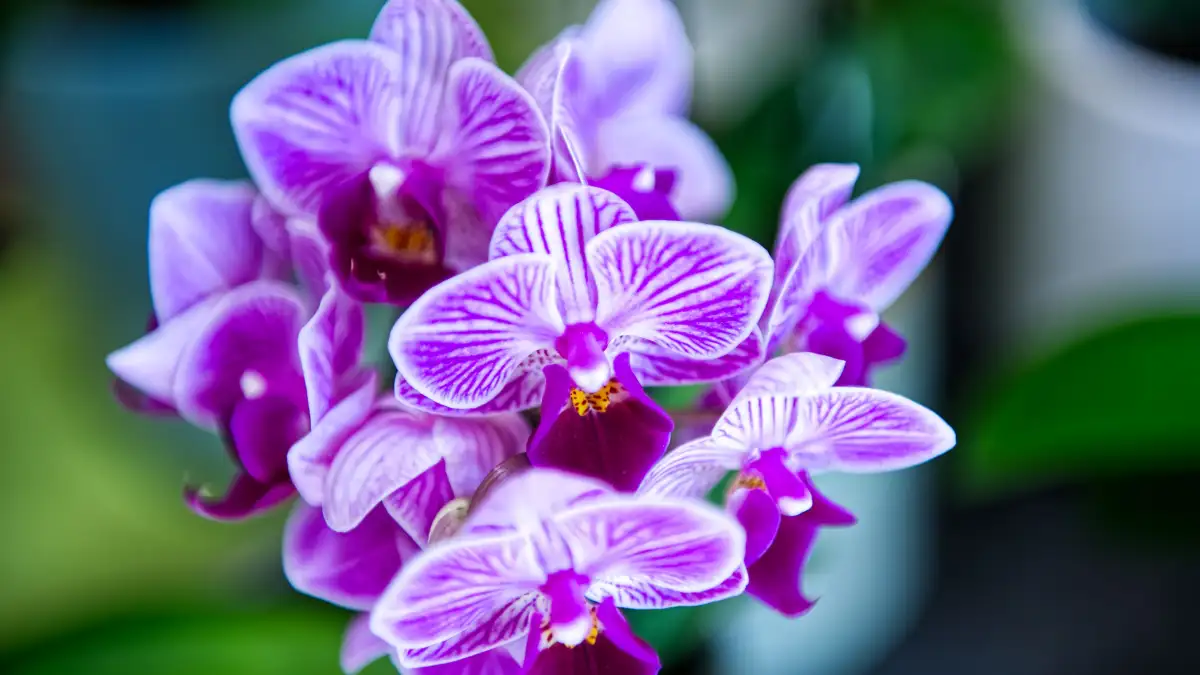
Orchid bark is coarse and water runs through it fast, which means less contact time and more salt left behind on the bark and root surfaces. By the time a phalaenopsis leaf shows tip dieback, the damage has usually been underway at the root tips for weeks. Knock the plant out of the pot and look at the growing roots. Healthy new tips are plump, pale green under a silvery velamen. Salt burn shows as a dry, brittle, brown or hollow tip on those very newest roots. Rot is a different picture entirely: mushy, dark, and it smells. Salt burn is dry and it starts exactly at the tip, where the dividing cells are.
African violets have a second problem, and it's temperature
Cold tap water striking African violet leaves leaves pale, bleached, sometimes translucent spots within a day or two. That isn't tip burn and it isn't chemistry; it's chilling injury on the blade. Letting the jug sit out overnight fixes that one, not because it removes anything, but because it brings the water to room temperature. Violets are also fluoride-sensitive, so they can show you both problems at once: bleached spots from cold water and dry brown tips from what's in the water.
The flush is the entire technique
Leaching is the single highest-value thing you can do and it costs nothing. Here's the whole procedure.
Take the pot to the sink. Run room-temperature water through the soil at roughly three to six times the volume of the pot. A six-inch pot holds about a quart of soil, so run two to three quarts through it and let it pour out the bottom. Let it drain completely, and do not let it sit in the runoff. The water in the saucer is a concentrated salt solution, and it wicks straight back up into the root ball.
Do this monthly for a peace lily, dracaena, or orchid on hard or fluoridated water. Quarterly is enough if your water is soft. Do it immediately any time you can see a crust. And if you're a bottom-waterer, this is the tax: bottom watering never leaches, so salts only ever go up. Flush from the top a few times a year regardless of your normal habit. Wait a week after a flush before you feed, since you've just reset the soil.
Water sources, sorted by what they actually fix
Tap left out for 24 hours handles chlorine and nothing else. Not chloramine, not fluoride, not hardness.
Rainwater handles all of it. No fluoride, no chloramine, essentially no dissolved minerals. A bucket under a downspout fills in twenty minutes of a decent summer storm, and a lid keeps the mosquito larvae out. This is what my violets and orchids get.
Distilled water handles all of it too. It's a dollar or two a gallon at the grocery store, which for two or three sensitive plants is not real money. It isn't a treatment or a supplement; it's just water with nothing in it.
Filtered water depends entirely on the filter, and most countertop pitchers and faucet cartridges are carbon, which takes out chlorine and some chloramine and leaves fluoride and hardness right where they were. Don't assume filtering solved the problem unless you know what the filter is rated to remove.
Well water has no fluoride, but it can be very hard, high in iron, or both. Test it or at least watch your fixtures for scale before you decide your tap is gentle.
The tips that are already brown will not heal
Trim them with clean scissors, follow the curve of the leaf, and leave a sliver of brown rather than cutting back into green tissue. Cutting into live tissue just creates a new wound edge that dries back anyway, and it leaves the leaf looking blunt. Don't take more than a few leaves at once on a plant that's already stressed. And don't treat every brown tip as a verdict on your care. A peace lily that tips slightly in hard water is still a healthy plant; you're managing an accumulation, not failing a test.
One more honest complication: low humidity and salt burn produce similar-looking damage and often show up together in the same room. Humidity damage tends to crisp the whole margin and hit newer leaves too. Salt and fluoride damage hits the tips of older leaves first and moves on a slow, steady clock no matter how attentive you are. When the tips advance no matter what you do with light, humidity, and watering, that's your signal to stop looking at the air and start looking at the jug.