Thanksgiving cactus bud drop is almost always a reaction to one sudden change rather than a pest or disease problem, and the triggers rank cleanly by how fast they reach the plant: a cold draft or a furnace blast lands within hours to a day, a moved or turned pot within a day or two, an interrupted dark period over several nights, and a swing in soil moisture across a week or longer. When buds start falling, work down that list from the top, and let the dropped bud itself tell you which one you are dealing with.
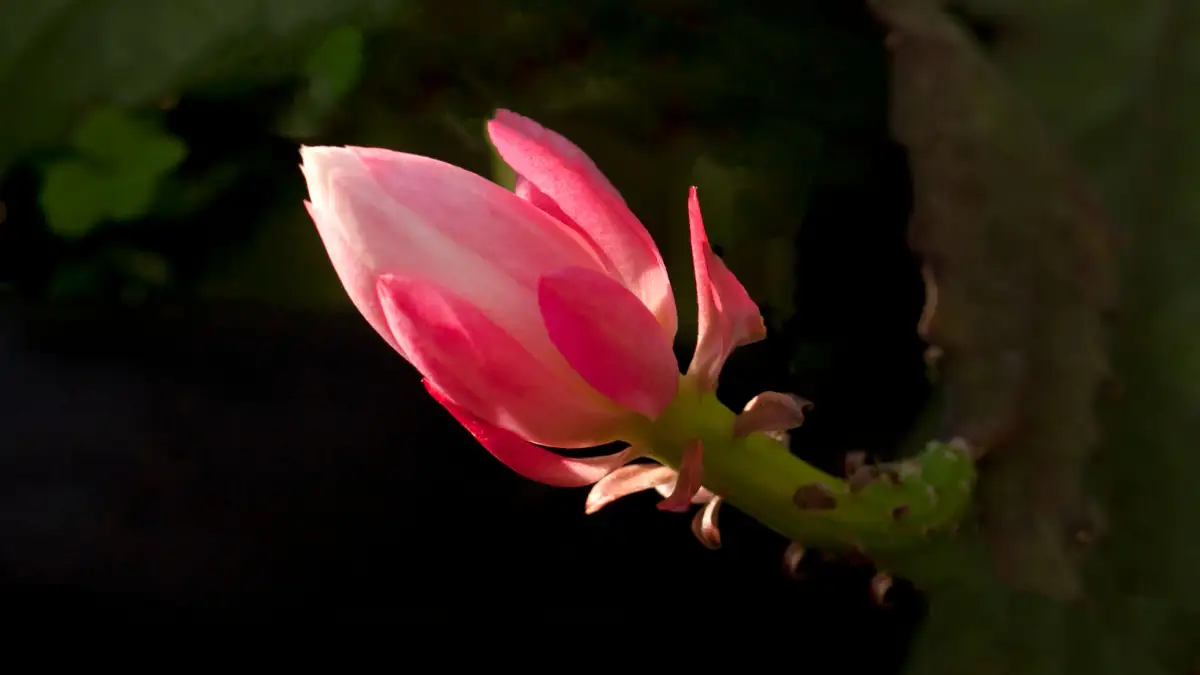
I was standing in the doorway with two bags of groceries when it happened. Middle of November, storm door clicking shut behind me, and the cold that came off the glass was not really a draft so much as a slab of air that rolled across the windowsill and then died. The Thanksgiving cactus lives on that sill. At the time it was carrying something close to forty buds, each one about the size of my smallest fingernail. The slab of air passed over it for maybe six seconds.
Three days later I ran a finger along the sill and came up with nine buds.
That is the part people skip past. Nine buds, and every one of them green and plump. Not yellow, not shriveled, not papery. Still firm. They looked like they had been picked off by hand. How a dropped bud looks when you pick it up tells you more about which trigger you are dealing with than anything you can read off a wall thermostat.
Sort by speed first, then look at the bud
Speed matters because the plant is tracking stability, not comfort. A change that arrives in seconds reads differently than a change that accumulates over a week, and the damage shows up on a matching timeline. So the first question is not "what is wrong" but "how fast did it arrive." A draft is an event. A drying mix is a drift. Those two things produce different-looking casualties.
The fast triggers: moving air, a moved pot, a moved light
A cold draft is the fastest thing on the list. Doorways, single-pane windows, sliding glass doors, a gap under a storm door, a window cracked for ventilation in November. In my house the sill runs colder than the middle of the room and the glass colder still, and the back of my hand on the glass tells me more than the thermostat in the hallway does. A few seconds of cold air moving across a budded plant is enough. Buds let go in two to four days, and they let go green and heavy.
Furnace heat is the same mechanism from the other direction. The register under the window pushes hot, dry air up past the sill, and the buds dry at the joint and drop. Those often look slightly dulled first, sometimes with a papery tip, before they release. If a vent blows toward the plant, the vent is the story, not the humidity.
This is where I part company with the usual advice. Warm moving air pulls water out of bud tissue faster than still dry air does, so treating humidity alone against a register is treating the smallest of three variables while the other two keep working. Temperature and air speed are doing the heavy lifting.
Next on the speed scale is the pot itself. Carrying the plant to the dining table so guests can see it, or just turning it a quarter turn to even out the growth. Both register as a change in light direction, and the buds on the side that got moved into shade tend to go first, a day or two later. I did the dining-table move one year. I don't anymore.
Slightly slower, over several nights, is a broken dark period. Thanksgiving cactus sets buds under long nights and keeps counting after the buds are visible. A lamp left on in that room until eleven, a television, a porch light through a window that wasn't lit in October. Several nights of that and buds abort. Two to five nights, typically, which is why people blame something else.
Repotting while in bud belongs here too, and it is the reason the old rule is to leave the plant alone until flowering finishes. It isn't superstition. It is the same trigger delivered through the roots instead of through the air.
The slow triggers: water and the root zone
Letting the mix go bone dry and then flooding it will yellow buds at the base, soften them, and drop them. Keeping the mix soggy for days gets you to the same place by a different road. This is the slowest category, a week or more, and the easiest to misread, because some bud abortion is normal on a heavily budded plant and it runs on a similar timeline. You cannot always separate the two, and I don't pretend to.
The tell is the bud itself. A bud lost to water almost never looks like the ones lost to the draft. It is dull, a little yellow at the joint, soft to the touch. Sometimes it hangs by a thread of tissue for a day before it goes. A draft casualty is firm and green and gone.
Low humidity on its own is the weakest suspect on the whole list. Dry air that isn't moving much gives you buds with dry, papery tips that may or may not drop. It contributes. It rarely starts the story.
Reading the sill afterward, and what I do next
The pattern of what's lying on the sill is a record. A scattering of dry, shriveled buds spread under the whole plant points to something that worked over time — moisture, humidity, root trouble. A tight cluster of plump green buds under one side of the pot, all about the same age, points to a single event with a direction. That's an afternoon, not a week.
Then I test, and I test without pulling. I rest a fingertip against a bud's joint with no pressure at all. A bud that has already let go will drop at that. A bud that is still attached will hold, and I can feel it hold. Anything that falls was already gone. Anything that stays is still in the running.
Once buds are visible I stop moving the plant. No turning, no repotting, no carrying it into another room for company. I water to keep the mix evenly moist but never wet, which is what I was doing before buds anyway, just more consistently, because inconsistency is now a trigger instead of a nuisance.
If buds have already dropped, the plant is not finished. The buds that stayed tight often keep developing. I have had plants lose half their buds in November and open a decent flush in December. What helps most is removing the trigger and then leaving the plant alone long enough to see what it does. It doesn't always work, and I've had years where it didn't. What I don't do is chase it with a second change — a tray of water doesn't undo a draft, and adding one fix on top of another just introduces another variable.
If every bud goes over the course of a week or so, that usually means more than one thing at once, often a draft plus a watering swing. At that point I let the flowering not happen, give the plant its rest, and start the long-night routine again the following fall. Thanksgiving cactus reblooms on a schedule you can repeat. A dropped set of buds is not the end of the plant, and it isn't even the end of the season.
I still keep the cactus on the sill. I just don't open the storm door beside it in November anymore.