A Thanksgiving cactus that has finished blooming belongs in a cool room, roughly 50 to 60°F, in bright indirect light, with no fertilizer at all and just enough water to keep the stem segments from shriveling, for about four to six weeks. Normal watering and feeding do not restart on a date. They restart when the plant pushes a new stem segment in early spring. The move into the cool room is the part that has to happen on time, because a plant that keeps being watered and fed in a warm room after its flowers drop spends the winter spending reserves it never gets back, and by March you are looking at something pale and stretched out and floppy.
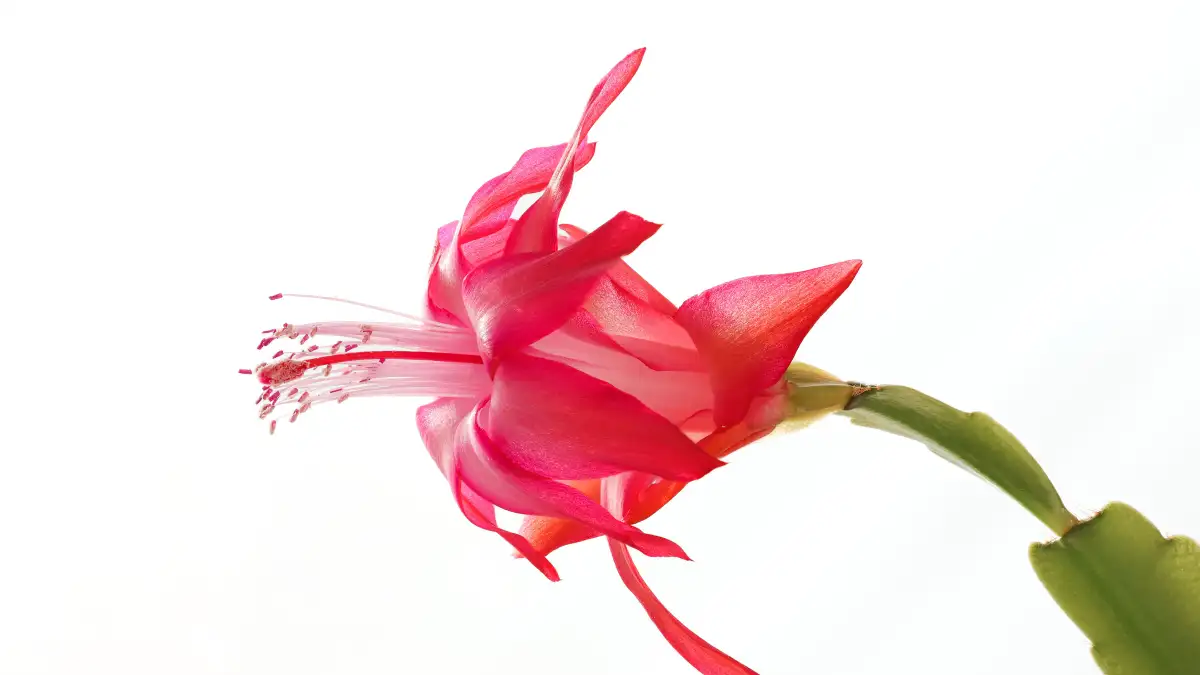
The last flower on mine is almost always tucked down near the base, half hidden behind a chain of segments, holding on two or three days after everything above it has gone brown and soft. When it finally lets go, a small papery drop onto the windowsill, that is the start date. Not when the plant looks tidy again. Not the weekend I get around to it. That one flower.
I move it that same day. The room I use is a spare bedroom over the garage with the heat vent closed and the door shut most of the day. It runs around 55 in January. There is a cheap thermometer on the sill next to the pot, and I trust that one more than the thermostat on the wall downstairs, because the thermostat is measuring a different room in a different part of the house.
What the cool actually does
Nothing in a Thanksgiving cactus shuts off the way a maple shuts off. It is not asleep. What the cooler temperature does is slow the whole plant down so it is burning through its stored reserves at a rate it can afford, instead of trying to build new segments on light that is weak and short.
And the cool and the drier soil go together. You do not get to pick one. Soil in a 55-degree room stays wet a long time. Keep watering on the old schedule while the plant is sitting in cool air and you get rot at the base, right where the lowest segments meet the soil line. I lost one that way years back, a plant I moved to the cold room and kept watering because the top inch of soil read dry to my finger.
The soil going dry is not the signal
Here is the thing I wish someone had told me earlier: in a cool room, the top of the pot dries out long before the bottom does. A Thanksgiving cactus in that situation can read bone dry at the surface and still be sitting in water an inch down. So I stopped checking the soil and started checking the plant.
I squeeze a middle segment on one of the younger chains between my thumb and forefinger. Firm and slightly cool, with just a little give at the joint where it meets the next segment, and I leave it alone. A week. Ten days. Whatever it takes. If the segment feels soft all the way through, like a deflated balloon rather than just a loose joint, it gets water, and it gets a small amount, poured around the inner edge of the pot. Not a soak. There is no schedule worth following here. The stem segments are the schedule.
Where 50 to 60 degrees exists in an American house
A lot of people read that temperature range, walk around their house, and conclude they do not have it. Usually they do, at night. A bedroom windowsill after the heat cycles off. A closed-off entry. A sunroom that gets cold once the sun goes down. A stair landing over an unheated basement. Any of those will do better than a 70-degree living room with a heat register pushing at it.
Two cautions. Do not let segments rest against single-pane glass during a hard freeze, because tissue touching cold glass goes soft and translucent and does not come back. And do not put it anywhere a heat vent, a radiator, or the top of a refrigerator can reach it, because the swing between day and night in those spots is bigger than the plant can absorb.
If your whole house genuinely runs warm, do not chase the number. A spot that holds steady in the low 60s with the watering pulled back will do more for the plant than a spot that hits 50 for four hours a night and then swings back to 70 by morning. Dryness and consistency are doing most of the work. The temperature is helping.
Light during rest
Rest does not mean dark. An east window is close to ideal. A west window in a cool, dry room is riskier than it sounds, because hot afternoon sun lands on tissue that is not growing replacement cells fast enough to keep up, and you get pale, sunken patches on the flat of a segment. If the only open spot faces west or south, back the pot off a foot or hang a sheer curtain. What you are avoiding is direct hot sun, not light itself. Six weeks in a dim corner produces a weak, pale plant that then stretches toward the first bright thing it finds in spring, and you spend the summer pruning what you grew wrong in the winter.
Nothing goes into the pot
No fertilizer during rest. Not half strength, not a bloom formula, not a light dose to keep it going. There are two reasons, and the second one is the one people miss.
The first reason is obvious: roots that are barely drinking are not taking up much, so most of it sits there. The second reason is that in a pot being watered every ten days instead of every four, nothing is flushing through. Salts from fertilizer accumulate instead of washing out, which is what you eventually see as a pale crust on the rim and across the top of the soil. A plant that gets a little fertilizer all winter can come out of rest with scorched root tips and then sulk through most of the spring, and the owner usually blames the rest period instead of the feeding.
What I do with the shears while it rests
Once the flowers are off and the plant is in the cool room, I look at the shape. Anything floppy, cracked, or draped over the edge of the pot comes off at the joint where it attaches to the segment below, using a clean blade. Mid-rest is actually a decent time to heal a cut, because the plant is at its lowest demand of the year and is not trying to do anything else.
But I take two or three segments, not half the plant. Heavy pruning plus dry soil plus no food is three stressors stacked on top of each other, and one of them will win.
The pieces that come off can be rooted. I let the cut end callus somewhere dry and out of direct sun for a few days, then set it into a small pot of something gritty. Rooting in water works, but the roots that form are built for water and go through a rough transition when they hit soil, so I skip that step.
How I know it is spring
The signal is a new segment at the tip of the youngest chain. It is a small nub, brighter and paler green than everything behind it, and softer. When that shows up, the rest is over. Not the calendar. Not the first warm day. Not the weekend I repot everything else in the house.
Waking it up without drowning it
I water normally for a week or two before anything goes into the pot. Let the roots come back online on plain water first. Then a dilute feed. Then normal strength once the new segments have firmed up and stopped reaching.
Feeding at full strength on the first day you see new growth is the mistake I made early on, twice. You get a fast, thin, floppy flush of segments instead of a compact one, and the plant looks worse in June than it did in March. That flush is not the plant being healthy. It is the plant spending energy it did not have yet.
What the rest does not do
It does not guarantee a bloom next year. It does not guarantee a bloom at all this coming fall. Some Thanksgiving cacti rebloom on their own in spring no matter what you do with them. Some skip a year entirely. A plant that came home from a store shelf and bloomed on a forced schedule is often getting its first real chance to simply recover, and recovering and reblooming are not the same task.
What a genuine cool, dry rest does is put the plant in a condition where blooming again is possible. That is the honest version. It is not a trick and it is not a switch.
One last thing, because I muddled these two for a while. The post-bloom rest is not the same event as the fall temperature drop. The fall drop is what sets buds, it happens in September and October, and it has a different purpose entirely. If you mix them up, you end up dropping the temperature in January hunting for buds and watering hard in November hunting for recovery, and neither plant does what you want it to.