Run a thumb down the edge of a stem segment and the question answers itself in about three seconds: pointed, claw-like teeth mean Thanksgiving cactus (Schlumbergera truncata), while smooth, rounded scallops mean Christmas cactus (Schlumbergera x buckleyi). Bloom timing backs it up — truncata starts in late November, buckleyi pushes into December and January — and the pollen-bearing anthers settle it, yellow on Thanksgiving, purplish-brown on Christmas. The tag almost never helps, because nearly everything on the retail pallet ships as "Christmas cactus." The stem is the honest part of the plant.
Do it at the window, not on the shelf
I take the pot off the shelf and carry it to the nearest window before I decide anything, because overhead store light flattens the one feature I actually need to see. Held up against daylight, a stem segment turns into a silhouette, and the edge geometry stops being a matter of opinion.
Then I run my thumb from the base of a segment toward its tip, along one side.
On a Thanksgiving cactus my thumb catches. Not hard — just enough that I notice it, three or four times down the edge, each point tipped with a tiny dry bristle sitting in the areole like a claw with a sheath. The points curve slightly toward the growing tip. Say "crab claw" out loud while you're looking at it and the nickname stops sounding like marketing.
On a Christmas cactus my thumb slides. The edge rolls in shallow scallops, two or three per side, and if there are bristles at all they sit down in the curve of the notch rather than out on a point.
Here's the mistake that costs people a whole season: checking the wrong end of the plant. A Thanksgiving cactus's oldest segments, the ones sitting near the soil line, thicken and round off as they age. I've watched someone inspect the bottom three joints of a truncata, announce "rounded, it's a Christmas cactus," and then wonder in January why nothing happened. Look at the two or three newest segments at the growing tips. Those never lie.
The flowers, once you have them
Flowers are the confirmation, not the first test — you only get them once a year, and identification matters well before that.
Two things I check. First the anthers, the little pollen-bearing knobs clustered around the center. On a Thanksgiving cactus they read yellow, sometimes gold, sometimes almost a butter color. On a Christmas cactus they're purplish-brown, and the difference is unmistakable when the two plants are sitting on the same windowsill. If the petals have already wilted but the stamens are still standing, that's a free, clean look at them.
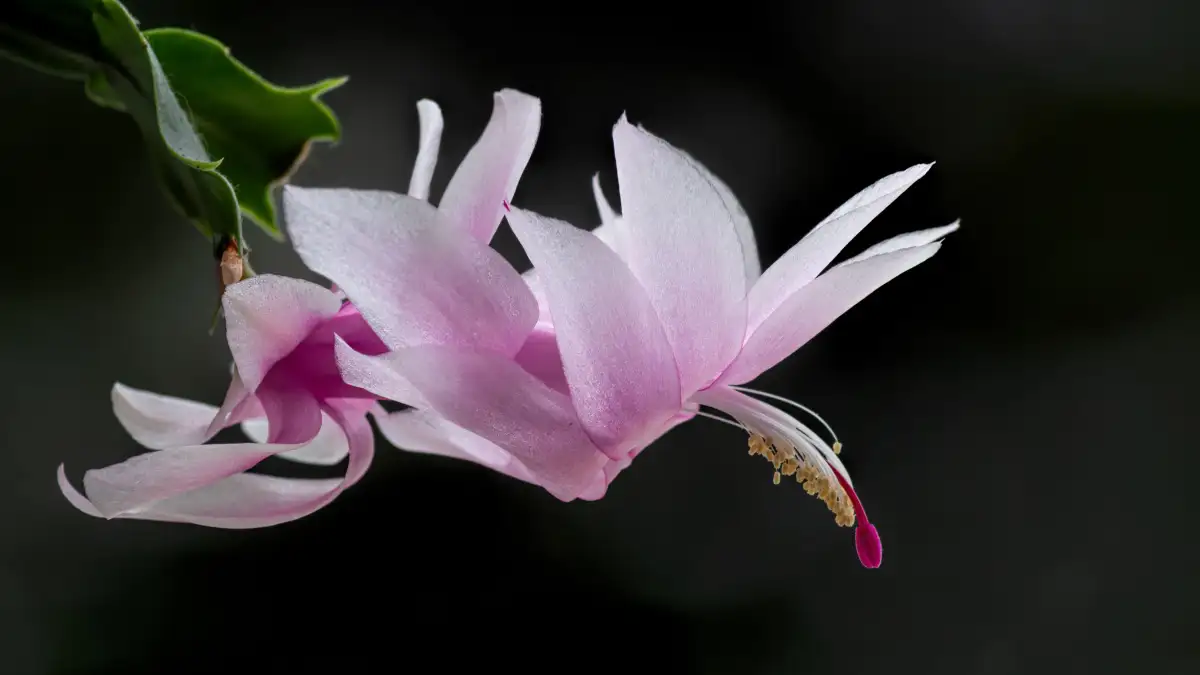
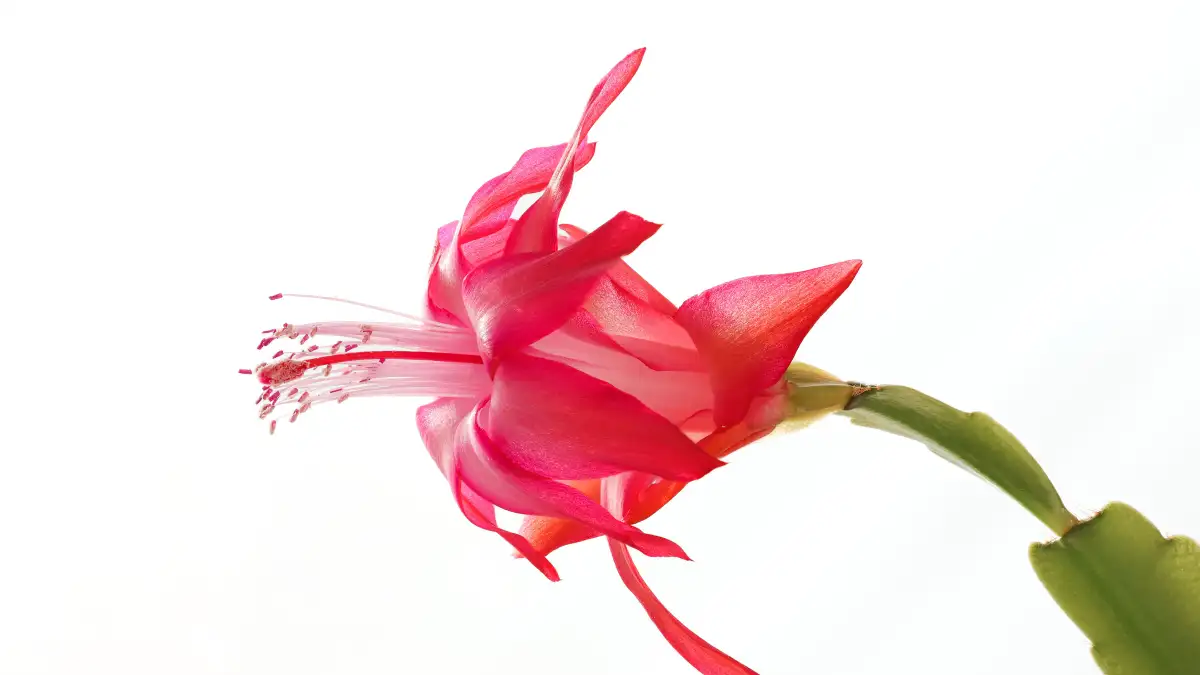
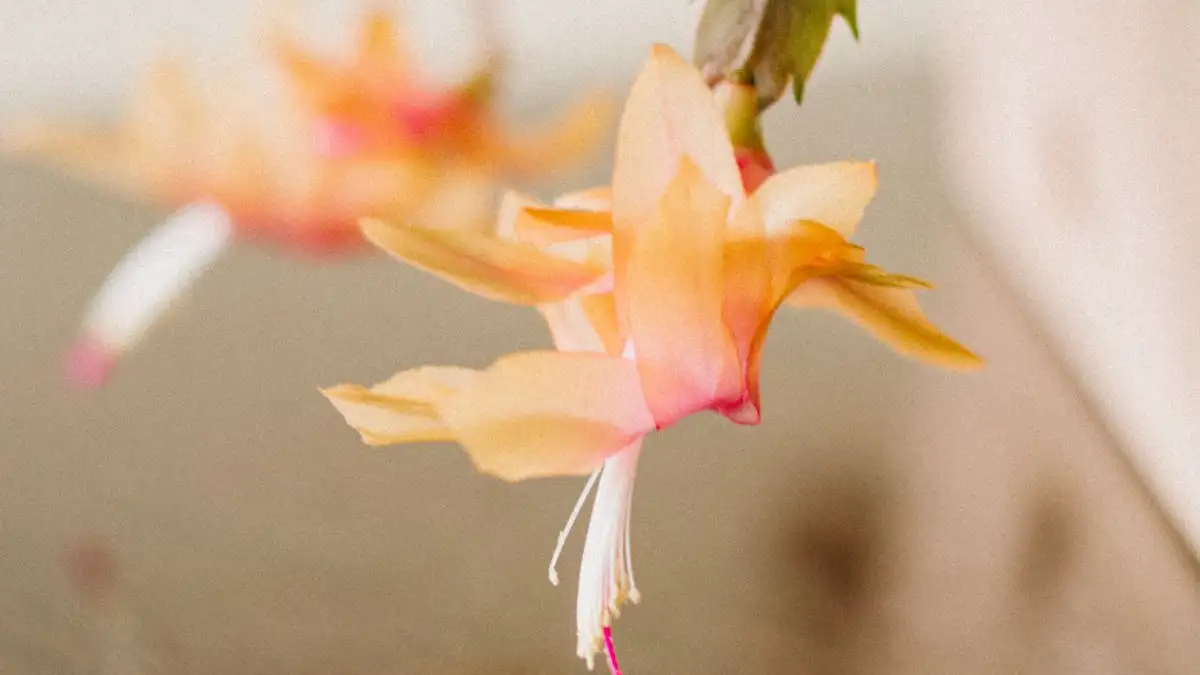
Second, the posture of the flower. Thanksgiving cactus flowers tend to face outward, the tube angling up and away from the segment like it's reaching for something. Christmas cactus flowers hang. The tube droops, the bloom dangles below the joint, and on a mature plant the whole thing cascades. Color is close to useless as an identification clue — truncata has been hybridized into white, salmon, orange, red, and a dozen pinks — so I don't lean on it.
The tag is a shipping label
Growers label for the market, not for the botanist. "Holiday cactus" and "Christmas cactus" sell in November; "Schlumbergera truncata" does not. You'll also see the old name Zygocactus on older pots, and "crab cactus" on some. None of it is exactly a lie — it's a category — but it isn't identification either.
So I treat the tag as a receipt. It tells me when the plant left the greenhouse. It doesn't tell me which species is in the pot.
Where identification actually pays off
This is the part I care about, and the part that never shows up on the tag.
Both plants are short-day bloomers. They need long, uninterrupted nights to set buds — in my house that runs about thirteen to fourteen hours of real darkness, with cooler nights helping the process along. The trigger length is similar. The timing is not, and that's the whole point.
For a Thanksgiving cactus I stop pinching the growing tips around the first week of September, and if I'm going to manage the dark period deliberately I start it in the last week of September or the first week of October. Buds set, and the plant blooms late November into early December, which is what it's built for.
For a Christmas cactus I leave it alone through September, take a last pinch in late September, and don't start the long nights until mid-to-late October. The buds come in December and open into January.
Run the Thanksgiving schedule on a Christmas cactus and you're pushing a plant that wants a later trigger. Sometimes you get buds too early; sometimes the whole thing stalls and you get nothing. Run the Christmas schedule on a Thanksgiving cactus and you've simply missed November — you'll still get flowers, just a month or six weeks after everyone else's, and you'll spend that month convinced something is wrong with the plant.
A word on "darkness," because this is where I've lost the most blooms. The plant doesn't know what night is. It knows whether light is falling on its segments. A porch light through the window, a lamp left on across the room, a television — any of it can break the cycle. One of mine sat under a reading lamp two Decembers ago and produced exactly nothing, no buds, not a single one, while its neighbor six feet away in the corner bloomed heavily. Same water, same soil, same window. The lamp was the difference.
The honest limits
A lot of what's sold now is hybrid, and a cutting can carry a mix of ancestry that doesn't read perfectly against either description. If a plant has pointed teeth but blooms in January, the teeth win the identification argument; the late bloom just tells you the dark period landed later than the plant wanted. And if it has teeth and blooms in late November, treat it as a Thanksgiving type and set next year's schedule to match. The plant's own calendar is the final authority — you're not assigning it a species, you're reading one off it.
Also: once buds are set, stop moving the pot. Bud drop on these plants is almost always a draft, a temperature swing, or a plant that got carried into another room to be admired. Repotting during bud set is a dependable way to lose the entire flush.
If it's neither
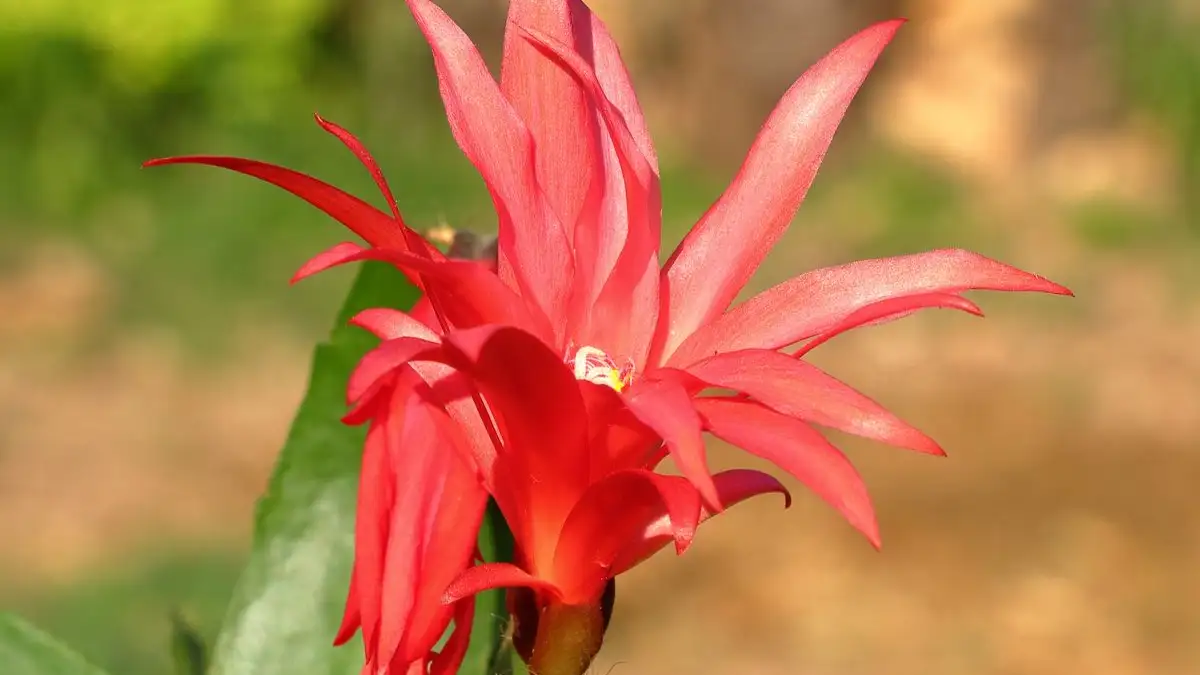
There's a third plant that gets mislabeled the same way. Easter cactus (Rhipsalidopsis gaertneri) has segments rounder and smoother than any Christmas cactus, with a distinct tuft of bristles crowning the tip of each segment, and it blooms in spring — April, sometimes March. If your plant has no points at all, a little bristle crest at the end of every segment, and it's showing color while everything else is finished, you're not looking at a Christmas cactus, and the dark-period schedule you wrote down is for the wrong plant.
Stem shape is a three-second test, and it's the only one that works before the flowers show up. Get it right and you know when to stop pinching and when to start counting dark hours. Get it wrong and you spend December waiting on a plant that made its decision back in October.