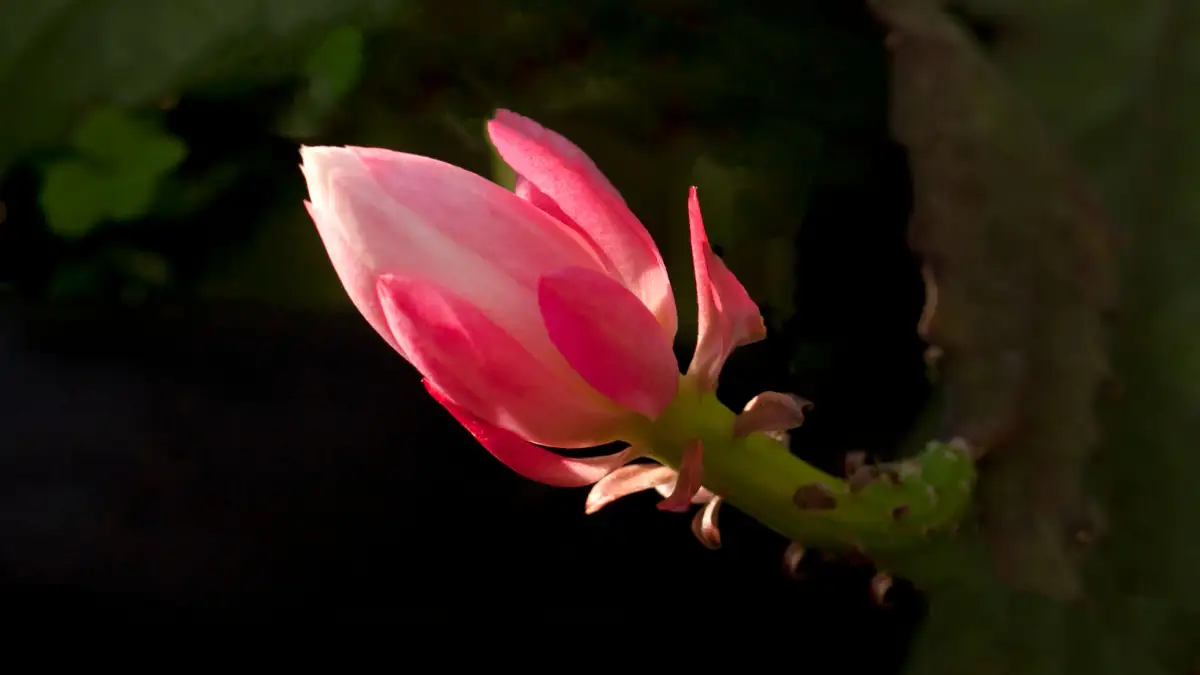
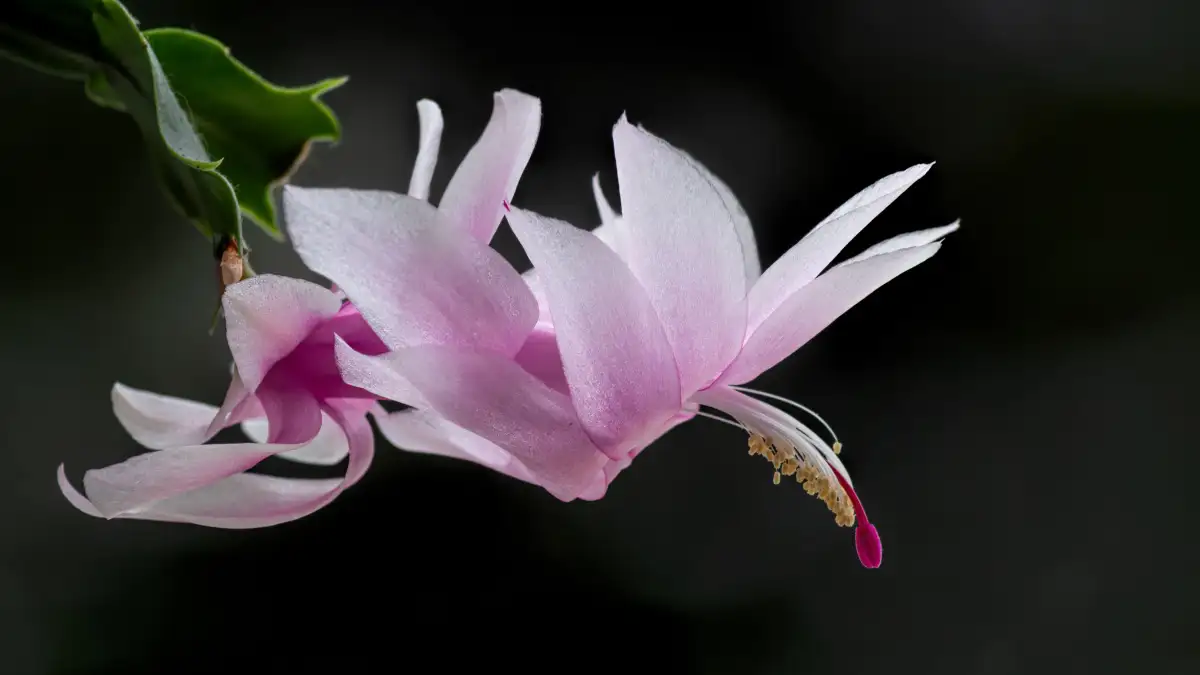
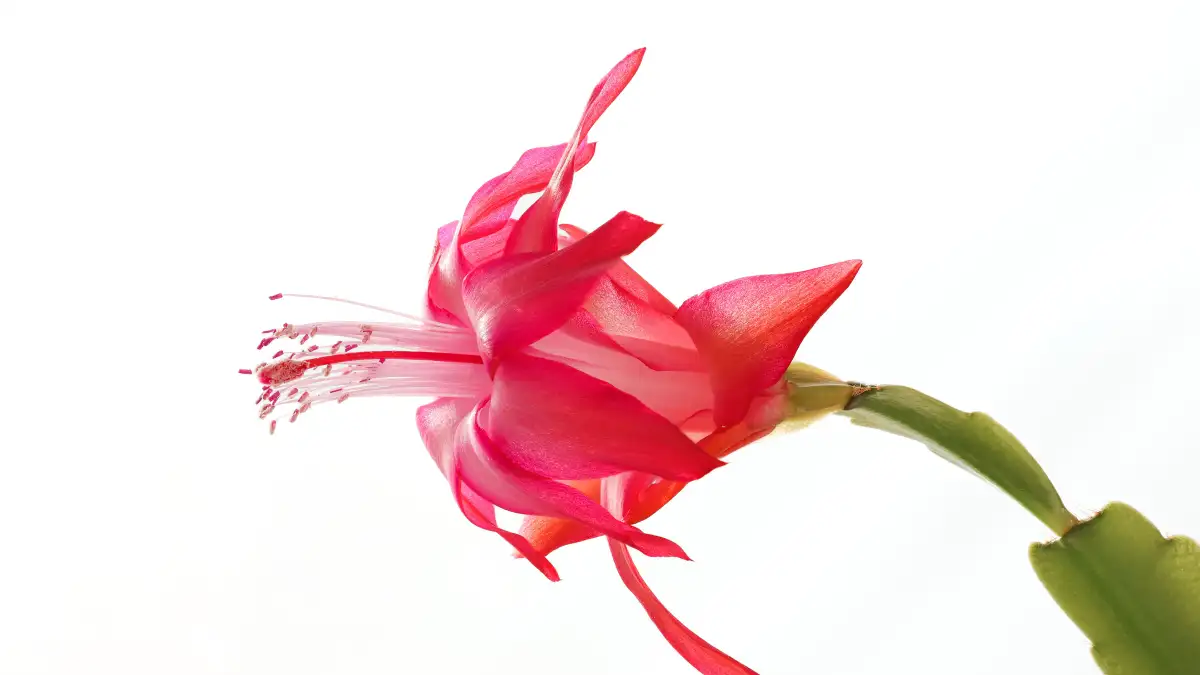
Repot a Thanksgiving cactus in late winter, in the gap between the last dropped flower and the first push of new growth. Not before. A plant carrying buds is running at peak demand — every bud is a straw pulling water and sugar through fine roots — and root disturbance cuts that supply at the exact moment the plant has the least margin for error. Once buds abort, they are gone for the year; the next chance comes with the following fall's short days. Late winter also happens to be when the plant is rebuilding roots on its own, so recovery overlaps with work it was already going to do.
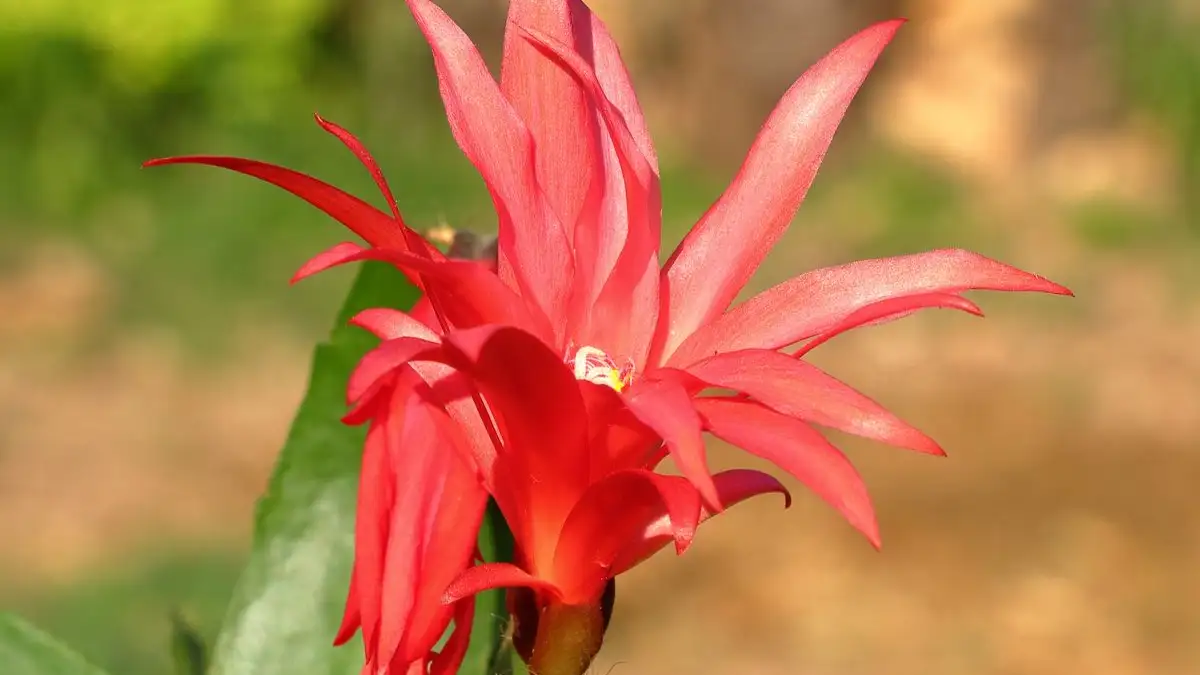
The morning I stop waiting
The third week of February. The last flower has gone limp and papery, dropped onto the windowsill, and left a small bare nub where it was attached. That nub is my cue. Newspaper down, plant on its side, no rush.
I do not water it first. A barely moist root ball slides out of the pot in one piece and the old mix crumbles away between my fingers. A soaked one comes out as a wet brick that smears and clings, and I do more damage prying it apart than the repot would have done on its own. If I know a repot is coming, I skip the last watering before it.
Why the calendar matters more than the technique
Thanksgiving cactus — Schlumbergera truncata, the one with pointed teeth along the stem segments, not the rounded-edge Christmas cactus — has two seasons that matter. Fall is for setting buds. Late winter and spring are for growing. Those are not the same job and they do not want the same treatment.
In fall the trigger is shortening days and cooler nights. Once buds are visible they are the plant's entire priority, and they are fragile in a specific way: the plant will abort them to protect itself. A cold draft, a two-foot move across the room, one missed watering, and you can lose every bud on the plant inside a week. That is not a quirk. It is the plant shedding a demand it can no longer meet. Cut the water supply by tearing fine roots and you have handed it the same problem on purpose.
And a dropped bud does not regrow. The bloom window is set by photoperiod, and once it has passed, it has passed. There is no replacement flush in January. You wait eleven months.
By late February the equation has flipped. Flowering is done, days are lengthening, and the plant is pushing new segments at the tips. New roots come with that. Repot now and you are not asking the plant to recover from something — you are redirecting a process it already started.
How to tell the bloom is really over
Not by the pause between bud flushes. Every so often a plant flowers, rests a week or two, and pushes a second round. Repot in that gap and you have repotted in bud, just earlier than you intended.
Wait until the plant has been flowerless for a couple of weeks and you can see the first tiny new segments starting at the stem tips — smaller than the mature segments, and a brighter, softer green. That is the signal. New growth means the plant has turned the corner.
If you have already missed the window
Sometimes the mix has gone to slop in September and the plant is listing out of the pot. Waiting until February is not realistic. In that case, early summer is the compromise: June, with a long stretch of growing weather ahead and months to go before short days return. It is not as good as late winter. It is far better than repotting straight into the fall bud set.
The pot should be smaller than you want it to be
This is the mistake that comes right after a timing mistake. These plants are epiphytes. In habitat they grow on tree branches in pockets of accumulated leaf litter, roots packed into a small volume of airy debris. The root system is fine, dense, and breaks easily. Give it a pot with four or five inches of soil on every side of a small root ball and you have made a container full of wet mix with almost nothing drinking from it. That is the mechanism behind most rot in these plants — not the mix, not the watering can, the volume.
One to two inches wider than the root ball is plenty. On a plant that is otherwise happy I will go the same size and simply replace the mix. They bloom a little better slightly snug, and there is no upside to giving roots room they will not fill within a year.
A drainage hole is not optional. A pot with no hole is a different object with a different purpose.
The mix
Fast-draining, but it still has to hold moisture. A standard potting mix, perlite, and orchid bark, roughly two parts mix to one part perlite to one part bark. I do not measure; I eyeball it. The target feel is consistent: squeeze a handful and it holds together, poke it and it falls apart. The bark is what keeps air pockets open after months of watering. Perlite does the same work at a smaller scale. Nothing heavy, nothing that compacts into a slab and stays that way.
Getting the old mix off without destroying the roots
Shake, do not wash. A stream of water strips root hairs and fine roots, and that is exactly the tissue the plant needs to take up water in the weeks after. I loosen the old mix with my fingers, work the stubborn parts with a chopstick, then shake. Whatever stays wedged in the middle of the root ball stays. It is not worth tearing roots for tidiness.
While the root ball is in your hands, look at it. Firm and pale is what you want. Mushy, dark, and collapsing at the base is rot, and fresh mix in a clean pot does not fix that. Repotting is not a treatment; it is a timing and volume decision. Rot is a separate problem with a separate answer.
The first water
Wait three or four days. Roots break during repotting and those breaks are open tissue until they seal. Then water lightly — not a soak, just enough to settle mix around the roots. After that, back to normal.
No feeding at first. Fresh mix carries enough to get going, and I wait until I can see new segments before I give the plant anything.
Keep it out of direct midday sun for a week or two while it settles.
How often this actually needs to happen
Every two to three years, or whenever the plant tells you. The signals are consistent: roots coming out of the drainage hole, mix collapsed and shrinking away from the sides so water runs straight down the gap and out the bottom — which looks like excellent drainage and is actually a bone-dry root ball — the pot tipping over, or new growth stalling on a plant that had been growing fine.
One repot in the right week beats three in the wrong ones. That is the whole idea.