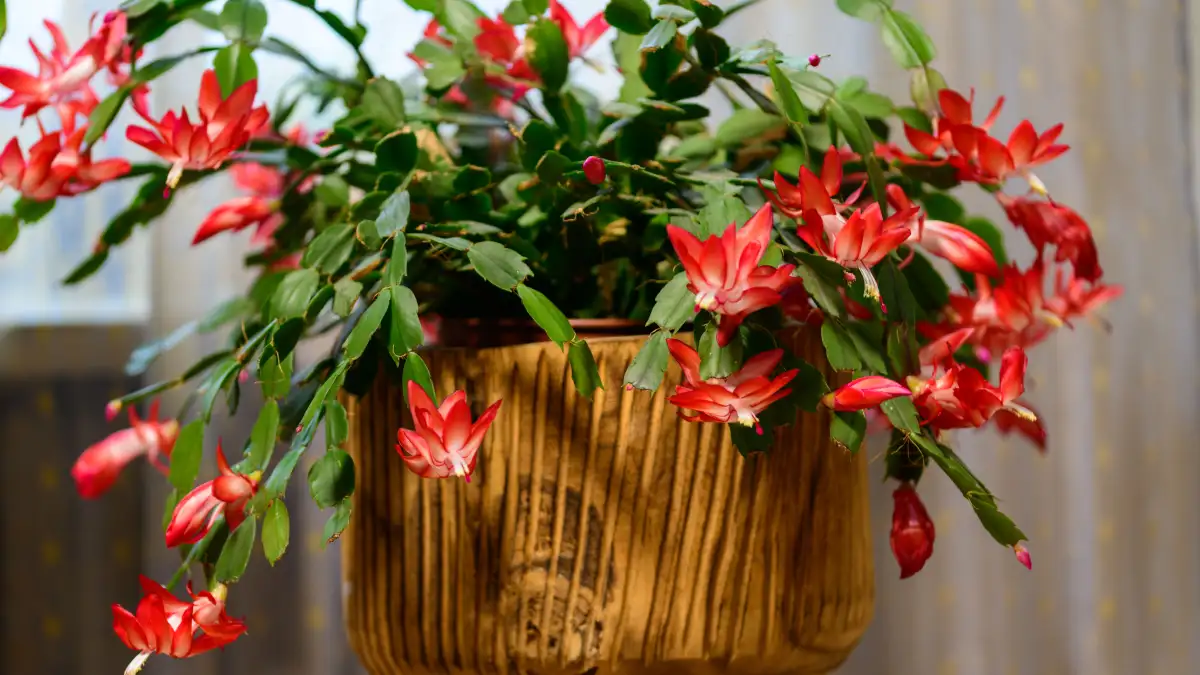
A Christmas cactus sets flower buds after roughly four to six weeks of nights that stay completely dark for twelve to fourteen hours at a stretch, and the reason most indoor plants never get there is rarely the length of the dark period. It is a leak: a table lamp left on until ten, the standby light on a television, a phone screen, a strip of hallway light under the door, a streetlight through the slats of a blind. The plant is not tallying total hours of darkness. It is reading whether one long stretch of night got broken, and an interruption in the middle resets the count. So the real work happens in the room the plant already lives in. Get that room dark after supper and bright all morning, and leave the pot where it is.
I have run this both ways, and the closet is the way that cost me a set of buds. Two Octobers ago I moved a healthy plant into the spare-bedroom closet at six every evening and carried it back to the window at eight the next morning. On day four of week four I came through the doorway too fast and clipped the top segment on the jamb. Pink points across the carpet. Six weeks of patience, on the floor.
The night I actually understood the problem, I stood in the dining room at nine with every switch in the house off, just to see what the plant saw. My eyes took about a minute to adjust. Then the room filled in. The blue dot on the power strip under the sideboard. The orange wash of the streetlight coming through the slats and around the edges of the blind. A yellow stripe under the hall door. The little red standby light on the television that I had never once noticed in eleven years of living here. That was the plant's night: not dark, just dim.
Start the clock from the date you want flowers
Work backwards. If you want flowers around Christmas in the United States, that usually means starting the short days in late September or early October. For a Thanksgiving bloom, mid-September. Count six to eight weeks back from the date on the calendar and mark it, because the schedule only works if it runs long enough and consistent enough to register.
The dark block itself is four to six weeks of that window. That is the part the plant tag gets wrong. The dark treatment stops when buds appear, not when flowers open, and the buds then need several more weeks in ordinary light before they actually open. So the six-to-eight-week figure from the calendar is really dark period plus bud development. If you only budget six weeks total, you will be staring at tight green tips on Christmas morning.
Daytime light matters as much as the night. The plant wants eight to ten hours of bright, indirect daylight, the kind you get from an east window or a south window that is shaded or set back from the glass. A closet gives it nothing for those hours, and nothing is not neutral. Six weeks of near-darkness in the daytime leaves a plant with no reserves to build flowers out of.
The darkness has to be one piece
Photoperiod plants do not measure dark by the hour. They measure it by continuity. There is a pigment in the leaf that flips to one form in darkness and back to the other in light, and what the plant reads at dawn is how far that flip got. Break the night in the middle with an hour of lamplight and the pigment flips back. The night effectively restarts. Two twelve-hour nights with a lit hour in the middle are not the same as one uninterrupted stretch of darkness. They are not even close.
This is why a small leak is not a small problem. It is not that the plant needed twelve hours and got ten. It is that the plant needed one unbroken run and got two short ones.
If the room cannot be made dark
Some houses have a room where the only light after six in the evening is a lamp that somebody actually uses. If you cannot win that argument, a cover is the fallback: a big cardboard carton or a doubled dark cloth over the pot, on at dusk and off in the morning. It works, but it has three failure modes I have hit personally. The plant gets left covered into the morning, which costs it daylight. The cover traps warmth, which is the opposite of the cool nights the plant needs. And anything rigid that lands on the tips flattens buds that took weeks to make. If you cover, keep it lightweight, keep it off the growing tips, and set an alarm for the morning.
The basement is rarely the answer. It is dark, yes, and it is also usually too cold, too damp, and too far from a window for the daylight half of the equation. A bathroom with a window can work if you can keep the light off at night. A guest room nobody sleeps in is the ideal candidate, and often the one a house already has.
Walk your room after dark
Here is the test, and it takes ninety seconds. After dark, turn off every light in the room, stand in the doorway, and wait a full minute without touching a switch. Let your eyes adjust the way they do at a campsite. Then look at the pot and ask what is shining on it. In my experience the answer is never nothing.
The leaks, in the order I usually find them:
- Lamps. Not off. Unplugged. A lamp on a switch gets turned on by a guest, by a partner, or by you at ten at night without thinking.
- Standby lights. The television, the cable box, the power strip, the small blue dot on the humidifier. A strip of tape over each one costs nothing and removes the problem entirely.
- The door. A rolled towel at the base kills the hallway stripe. So does closing a door everyone had been leaving open.
- The window. Close the slats and angle them down, then check the edges where light spills around the frame. In a lot of houses the bigger culprit is outside: a porch light, a neighbor's motion light, headlights from the street. A piece of cardboard wedged behind the blind on that side does more than any rearranging.
- Screens. A phone at eleven at night, held two feet from the plant, is a light source. The plant only sees the photons.
- Holiday lights. This one is seasonal and it stings. The window where the cactus lives is the same window someone in the house will want to string with lights in early December, which is exactly when your buds are a quarter inch long and about to drop.
Once those are handled, the plant can stay where it has been sitting all year. That is not just convenient. It is the whole point, and I will come back to why in a minute.
The temperature half of the dark period
Dark alone is half the signal. The other half is cool nights, roughly 55 to 65 degrees Fahrenheit. Warm nights, in the low 70s and up, stall bud set even when the darkness is perfect, and they are a common reason a plant that clearly got its long nights still does nothing.
This is where a window earns its keep. A window that gets dark at night is usually also the coolest spot in the room. But check what else is near it: a heat register under the sill, a radiator, a television, a lamp that runs all evening and warms the air around the pot. I keep a small thermometer next to the pot during the treatment, because the thermostat in the hallway tells me nothing about the microclimate four inches from a pane of glass.
Cold is a problem too, and it is the failure I see most in the northern half of the country. A single-pane window on a twenty-degree night is not a cool night, it is a draft, and a cactus that goes limp and reddish at the segment edges has been chilled, not encouraged. Rooms below 55 at night can also drop buds. Aim for cool, not cold, and move the pot a few inches back from the glass when a hard freeze is coming.
Water normally, only slightly less
The old instruction was to stop watering and let the plant dry out to force blooms. I do not do that anymore. Watering is not what triggers flowering in a Christmas cactus. The dark period is. What a drought does on top of long nights is set up bud drop.
What I do instead is keep the same routine with a small adjustment: let the top inch or so of the mix dry between waterings, slightly drier than in summer, and water thoroughly when it does, letting whatever runs through the drainage holes out of the saucer. Not bone dry, not a wet saucer sitting under the pot. A plant that is both dark and thirsty has no margin, and a bud that formed on schedule will abort at the first real stress.
I also back off feeding. Nothing heavy during the dark period. The plant is not trying to push leaves right now, and extra nitrogen sends it into soft new growth instead of flowers.
When the buds show up
Start checking the tips of the segments once a week, around week four. Buds show as tiny pink or red points at the very end of the last segment, often where you were not looking. They can appear as early as three weeks and as late as six. When they are about a quarter inch long, roughly the size of a small pea, the dark treatment has done its job.
Then undo it slowly. The plant does not need short days anymore to finish, but it is still holding those buds by a thread, and a sudden change in light or temperature is a known way to lose them. I stretch the light period about an hour a night for three or four nights rather than flipping from thirteen hours of darkness to a fully lit living room in one evening.
This is where the in-place approach pays off. The plant is already in the spot it is going to live. Nothing gets carried, nothing gets turned, nothing gets set down on a counter while you move a chair out of the way. Bud drop in December usually gets blamed on drafts or dry air, and both are real, but if I am honest about my own losses, the plant went from one light level to another too fast and it got moved at the worst possible moment.
Six weeks, no buds
Go back through the list before you blame the plant. A leak you missed, night temperatures sitting at 72, a fall repotting that disturbed the roots mid-treatment, or a summer of heavy feeding that pushed soft growth instead of mature segments.
Two other possibilities are worth ruling out. If it is a Thanksgiving cactus rather than a Christmas cactus, it sets buds earlier, and an October 1 start is already too late; mid-September is the date. If the plant is young, a rooted cutting or something with only a few full segments, it may simply not be mature enough to flower no matter how good the dark period is.
And one more, which took me years to accept. Some Christmas cacti on some windowsills already bloom every year with nobody doing anything at all, because the window was providing the long nights all along. If that has been your plant, the thing that changed is not the calendar. It is a new lamp, a new television, a moved chair, a strand of lights. You do not need to add a dark period to a plant that already has one. You need to stop interrupting it.
That is the whole trick, and it is mostly subtraction. I still stand in that doorway in October with the lights off, checking what the plant sees. It takes ninety seconds. The row of flowers in December is the receipt.