The overnight water jug does almost nothing about the disinfectant in most American tap water, because most of that water is no longer disinfected with plain chlorine. Chloramine — chlorine chemically bound to ammonia — is what a large share of utilities switched to, and it does not leave an open jug at any rate you would notice. Where the jug habit still works, it works on free chlorine, and it works faster than a night. The part of the ritual that genuinely helps the plant is the side effect nobody mentions: by morning, the water has come up to room temperature.
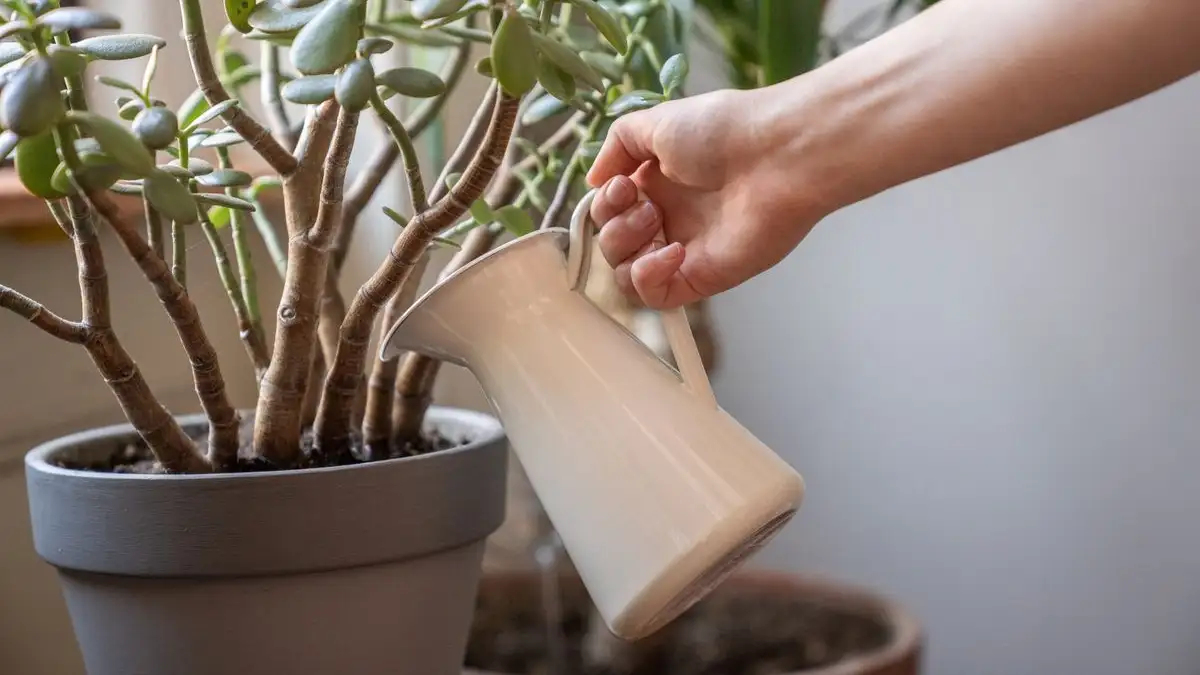
It's about nine at night and I'm at the kitchen sink with the jug under the tap. The water comes out cold — in January, cold enough that my fingers register it before I do — with that flat, faintly chemical smell people just call chlorine. I fill it to the shoulder, set it on the counter with the lid resting loose, and go to bed. In the morning I test it the way you test a baby bottle: wrist first. If it makes my wrist flinch, it isn't ready.
For years I thought I was doing chemistry. I was mostly doing temperature.
One jug, two chemicals, and only one of them listens
Chlorine is a dissolved gas. Leave a jug open and it leaves — that's why aquarium keepers and pond owners have used standing water forever. Give it roughly a day, sometimes less, and it's gone. Chloramine isn't a gas sitting in water; it's a compound. The chlorine is locked onto ammonia, and the pair stays put. A jug left overnight does nothing meaningful to it. A jug left a week still doesn't. Some fraction will break down eventually, because chemistry does happen, but "eventually" here is measured in weeks, not in the hours between dinner and breakfast.
There's a reason the switch happened, and it has nothing to do with plants. Chlorine burns off in long mains, especially in big systems where the far neighborhoods sit at the end of miles of pipe. Chloramine carries a residual all the way to the last house on the line. That's an operational decision. It just happens to be why advice written in 1985 and advice for the water coming out of your tap today are describing two different liquids.
Read one line of the report instead of guessing
Every public water system in the country publishes an annual water quality report — the Consumer Confidence Report. It's usually mailed, often posted online, and sometimes available only if you ask. Somewhere in it is a line about disinfectant: sometimes a table cell, sometimes a sentence in the body. It will say chlorine, chloramine, or chloramines. That one line decides whether your jug is accomplishing anything at all.
Don't try to smell your way to the answer. Free chlorine and chloramine both have an odor, and the smell gets fainter as the residual gets lower — which means the water you can't smell is not more likely to be chloramine, it's just water with less of either. One more wrinkle: a lot of systems run free chlorine for a few weeks a year, a deliberate burn to scrub biofilm out of the mains. If you happen to draw a sample during that window, you'll get the wrong answer for the other eleven months.
The part that actually earns its keep is temperature
Water straight out of the cold main is genuinely cold, and tropical roots did not evolve for it. Aroids, marantas, philodendrons — the whole warm-rain lineage — have roots whose membranes get less fluid as temperature drops, and uptake slows with them. I'm not talking about catastrophe. I'm talking about a plant that's already sitting in a dim January window, in a pot that dries slowly, getting drenched with something that feels like it came out of a refrigerator. That's a small, repeated stress, and small repeated stress is how most indoor houseplant problems actually happen.
The overnight jug solves that for free, and the fix doesn't require any belief about disinfectants. Which means you don't actually need a jug. A watering can filled an hour before you use it gets you the same result. So does drawing your water and letting it sit while you do the rounds of the other plants. The jug is one way to arrive at room temperature. It isn't the way.
What the jug was never going to fix
Common houseplants handle ordinary municipal disinfectant residuals without complaint. Pothos, dracaena, peace lily, spider plant, most philodendrons — the concentrations that arrive at a residential tap are far below the level where these plants register anything. So when someone says "my plant hates tap water," the disinfectant is usually not the story.
The story is what has been accumulating in the pot. Fertilizer salts, plus the dissolved minerals in the tap water itself, building up week after week because the pot gets a splash every few days and never a real flush. Brown tips on a dracaena, crisp margins on a spider plant, a white crust at the rim of the pot or on the surface of the mix — those are salt symptoms. They look like water-quality symptoms because they appear on the leaves, which is where the plant puts everything it can't get rid of.
My fix for that is unglamorous. I carry the pot to the sink and run room-temperature water through it slowly — two or three times the volume of the pot — until it's pouring freely out of the drainage hole. That's the intervention that addresses the actual problem. Notice that temperature shows up here too: cold water straight from the tap on a root ball already stressed by salt is not doing the plant any favors.
One case where tap water really is the wrong default, and it isn't about chlorine: softened water. If the house runs a water softener, the calcium and magnesium have been swapped out for sodium. That's a salt load delivered straight to the root zone every time you water. It's the single most common way I've seen someone un-knowingly pickle a houseplant, and no amount of standing in a jug changes it.
Boiling and filters are not shortcuts
Boiling genuinely works on free chlorine — it's volatile and a rolling boil drives it off fast. It does nothing reliable for chloramine. And boiling also evaporates water, which concentrates every dissolved mineral that was already in there. If your plants look like they're reacting to mineral buildup, boiling is the wrong direction: you've made harder water, faster.
Carbon filtration has the same split. The standard carbon block in an everyday pitcher or faucet mount is rated for chlorine reduction. Chloramine needs carbon specifically rated for chloramine, which takes more contact time and a different grade of media. If the packaging doesn't say chloramine on it, assume it means chlorine. Reverse osmosis takes out both, along with basically everything else — including the calcium and magnesium — and leaves you with water that has almost no buffering capacity, which is a whole separate set of decisions about what you're feeding.
The jug has a shelf life
Water sitting in a warm kitchen for four days isn't aged. It's a small pond. You get biofilm on the inside of the jug, a slick ring where the water line was, and if the lid is off in summer, mosquito larvae — I've poured those out. So the jug gets used the next morning, rinsed, and left upside down to dry. I don't top it off. Topping off means the oldest water in there never actually leaves.
What I actually do now
I still draw a jug at night, but I've stopped pretending it's chemistry. It's a temperature habit with a convenient shape. The water goes on the plants within about a day. A few times a year, usually when I'm repotting or when I notice crusting at the pot rim, every pot gets a proper flush at the sink. And I read the disinfectant line on my water report once, so that I know which of the two chemicals I'm dealing with instead of guessing from a smell that can't tell me.
If you're on a private well, none of the disinfectant half applies — there's nothing in the water to off-gas, and the jug is purely a warm-up tool, which is fine. And if your well water is hard, the jug still isn't your problem. The overnight habit was never wrong, exactly. It was just answering a question that stopped being the question.