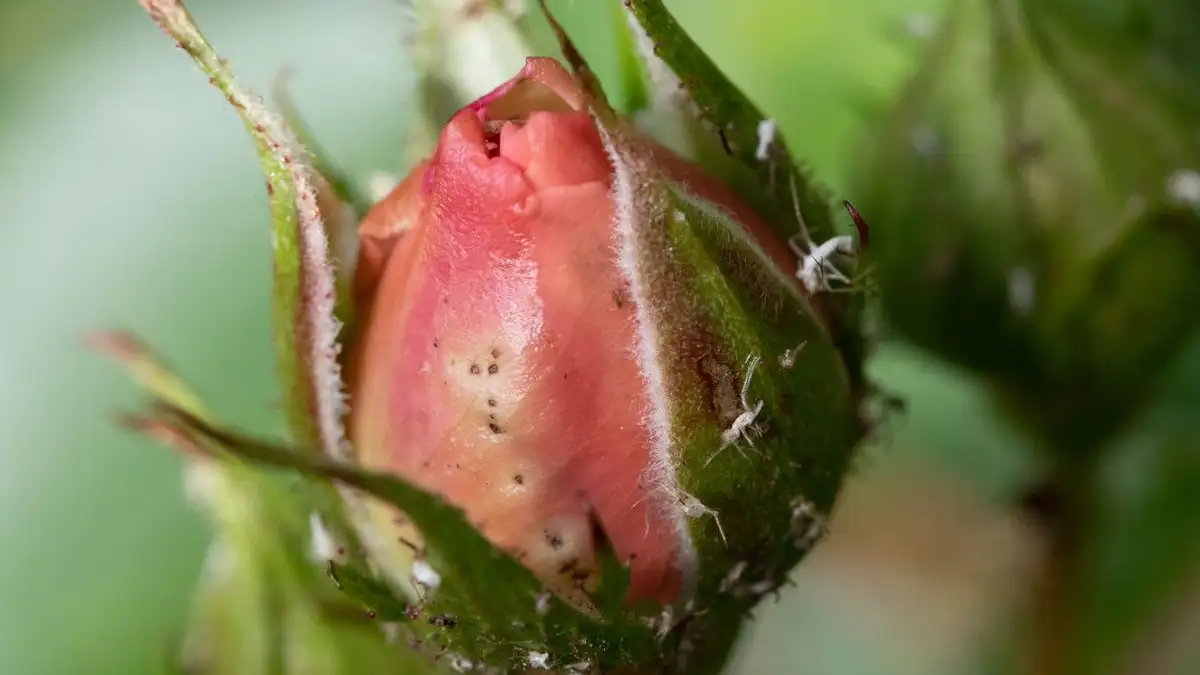
Black specks dusted across flower buds, together with silvery streaks and browned petal edges, are almost always thrips frass, the droppings of tiny slender insects feeding from inside the flower. The specks get noticed because they sit on the outside of the bloom; the insects that made them are usually wedged between petal layers inside a closed bud, where a spray applied from the outside never lands. Everything that follows, how you confirm it, why the spray already under your sink keeps failing, and what to expect from the flowers your plant is holding right now, hinges on that split between damage you can see and insects you can't.
I keep a stack of plain white index cards on the shelf with my plant tools, and the card is the first thing I reach for when a bud looks wrong. You hold it flat under the flower, tap the bloom twice with a fingertip, and look at what lands. Thrips frass looks like a fine dusting of black pepper. If you see that, watch the card for a few seconds, because a couple of those specks will start walking. Adults run about the length of a printed hyphen, narrow as a splinter, and they don't scatter the way whiteflies do. They walk. That is exactly why the card outperforms swatting at the flower.
Put a 10x loupe over the bud and the damage stops being mysterious. The silvery streaking is where cells have been emptied from the inside, and the petal surface looks scratched, like frosted glass someone dragged a fingernail across. Edges brown and go papery. Under heavy feeding the bud stalls shut, or it opens lopsided, one side of the flower smaller than the other, with the throat of the bloom discolored.
Not everything black on a petal is thrips, and I have talked myself into a diagnosis twice when it wasn't one. Once a flower stalk cracked and bled, and the dried sap flaked off in red-brown flecks. Once a plant simply dropped its pollen and it stuck. Neither of those walks. If the specks smear when you press them and nothing moves, you can put the card away and look somewhere else, at mite stippling on the leaves, at soil splash, at fungus gnats hovering over the mix rather than the flowers.
Why the spray only wets the outside
A closed bud is a sealed structure. On violets and streptocarpus there's a sheath wrapping the base of the flower stalk; on orchids, bracts cup the bud until it's nearly ready. Inside, the petals are pressed together in layers, and thrips wedge down into those gaps and into the throat of the flower. Meanwhile the petal surface is often waxy or reflexed, so droplets bead up and roll off instead of spreading. What a spray reaches is the outer surface of the bud, the outer petals, and whatever adults are walking around on the leaves. The larvae feeding two layers in stay dry.
That's not nothing. Knocking down the adults crawling on the outside slows the population from rebuilding, and the spray has a real job on the foliage, especially the undersides of leaves along the veins, where the same insects also feed and leave the same black specks. But it will not rescue the flower it lands on, and that gap between what you can reach and where the insects live is the whole reason this pest keeps winning.
There's a cost to spraying a plant in full bloom, too. Soapy or oily mixes can spot and burn petals, and wet flowers in a cool room are a standing invitation to gray mold. You are trading a cosmetic risk on the bloom you already have for a shot at the bloom coming next.
Sticky cards tell you what the flower can't
Blue and yellow sticky cards work because the adults are drawn to those colors. Placement decides what you catch. A card stuck upright at pot-rim height mostly collects fungus gnats coming out of the mix, which is a false alarm. Lay the card horizontally just above the buds, where the flower stalks rise, and you'll catch the flyers moving between blooms. Confirm with the card, then use it to decide when you're done: a fresh card that sits a week with nothing on it is better evidence than a gut feeling.
What the card won't do is control anything. I've pulled cards so loaded they looked furry while the flowers kept getting worse, because the population that matters is the one inside the bud, and no card reaches in there.
The bloom in front of you is already gone
This is the part I had to accept before anything I did started working. Once a petal has been streaked, that tissue does not recover. Worse, plants frequently abort buds they're already holding: the stalk yellows, the bud browns from the base of the petals, and it drops. So the realistic goal is not saving the current flower. It's a clean next flush.
That changes what you do with the ruined blooms. I cut them off rather than leaving them to sit, because eggs and larvae go out with them and every one of those is a thrips you don't have to fight later. The tradeoff is honest: on a plant in the middle of a flowering cycle, you may go weeks with nothing to look at. I take that deal every time, because a half-eaten bloom isn't decoration anyway.
Why one application never finishes the job
Eggs are inserted into plant tissue, into petals, leaves, and flower stalks. They survive the spray that kills the adults walking around them. That single fact is why the interval on the label is not a suggestion, it's a hatching interval, and why missing it puts you back at the starting line: the eggs you didn't reach hatch, larvae feed, new adults lay new eggs inside the plant. Two or three rounds on that schedule is normal, not excessive.
Every application needs to cover three places, not one. The undersides of leaves. The flower stalks and the sheaths around the buds. And the top of the potting mix, because many common thrips drop out of the flowers to pupate in the soil surface. Scraping off and replacing the top inch of mix, or simply letting the surface dry between waterings, shortens that stage. So does keeping fallen blooms and spent flowers off the shelf instead of letting them sit in the pot.
There's a category difference worth understanding here. Contact sprays kill what they physically wet. Systemic products are taken up by the roots and move into plant tissue, which is how they reach insects a spray can't, but they take days to weeks to climb through the plant, and they don't undo damage that's already there. That timeline is one more reason the target is the next flush rather than this one.
The reason I isolate first and move slowly
Thrips are known vectors of plant viruses, and that is what turns this from an annoyance into something else. A plant infected this way doesn't just look chewed. It throws ringspots, black necrotic blotches, and distorted new growth, and there is no cure for a virus once it's in the tissue. You manage it or you lose the plant.
So a suspect plant comes out of the collection immediately. I move it to a different room and keep a closed door between it and everything else if I can, because a plant I've had for six years is worth more than the convenience of leaving a problem where I can see it. I wash my hands between plants and wipe my snips. And new plants from a store, which is where most of these introductions start, sit on their own shelf for three to four weeks before they join anything else.
What a clean flush looks like
The check is simple and it's the same check every time. When a new bud starts to color and open, tap it over a card. A blank card, petals that unfurl fully without silvery drag marks, no pepper anywhere on the flower, that's clean. And the earlier you start looking in that window, the first day or two after the color shows, the more room you have to act before the whole flush is written off. If you only notice once the flower is fully open and streaked, you're already planning one flush ahead.
I've stopped thinking of this as an insect problem. The insects were never the thing I was looking at. The specks on the card were, and they showed up long before I could have found a single thrips inside a bud that hadn't opened yet.