Move an African violet up exactly one pot size — the four-inch plant goes into a five — and only when the root ball has filled the pot it is already in or the medium has collapsed and stopped draining. A larger jump leaves a collar of unrooted soil holding water that no root can reach, and that collar is where violet roots and crowns rot. The plant to aim for is one that is very nearly too big for its pot, not one that has room to spare.
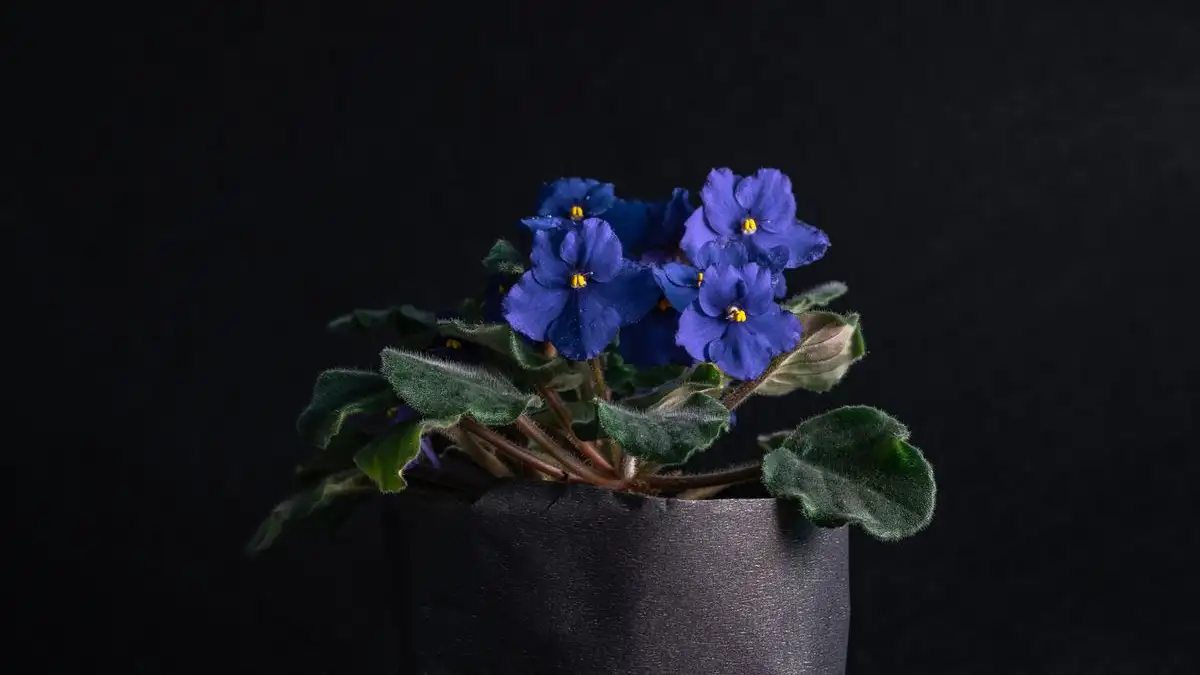
I keep a short stack of clean fours and fives on the shelf under my bench, and I reach past the fours for a five far less often than most people would expect. My rule after a lot of Saturdays of this: if I'm not sure it needs it, it doesn't.
Put the plant in your hand before you touch a pot
The decision gets made standing up, not sitting down. I pick the violet up and let it sit in my palm. A plant that has filled its pot feels dense and slightly bottom-heavy — the medium, the roots, and the pot read as one object. A plant that is still working on the space feels top-heavy and a little hollow, and if I tap the side of the pot with a fingernail I can hear how much of it is air. That one goes back on the tray.
The other trigger is the medium itself, and it announces itself a different way. Collapsed violet medium shrinks away from the pot wall until there is a visible gap you could drop a pencil into. You water, and it runs straight down that gap and out the drainage hole in a second while the root ball in the middle never gets wet. That plant needs repotting regardless of how much root it has, because the medium has stopped doing the one thing medium is for: holding moisture evenly and letting air move through it.
That second case is why I don't repot on a calendar. A violet in a light, fast-draining mix, in a pot it hasn't outgrown, can sit for a year and a half and be perfectly happy. A violet in a fine, heavy peat mix that holds water like a sponge can be in trouble in the same pot in eight months. The mix matters more than the schedule, and it is the peat that keeps a violet's roots wet long enough to die.
The squeeze, the tap, and what slides out
Once I've decided, the plant comes out the same way every time. Turn it upside down with the crown between my first two fingers, tap the rim of the pot against the edge of the bench — not hard, just enough to break the seal — and let gravity do the rest. If the plant is ready, the whole thing slides free and the medium is still holding the exact shape of the pot: a cylinder with a wall of white roots pressed against the outside and finer roots threading into the middle.
If it comes out in wet clumps, or if I have to pull, I stop. Pulling tears the fine feeder roots that do the actual work, and those are the roots that take weeks to grow back.
And this is the part people skip, which is the part I'd defend hardest: the root ball is the only time you ever get to see the whole root system. Ten seconds on the bench with it in your hand tells you things you would otherwise guess at for months.
The root ball is a diagnostic, not a formality
I break it apart gently with my fingers over a sheet of newspaper and look at what I've got.
Healthy violet roots are pale, firm, and slightly hairy, with tips that look almost translucent. Mealybugs look like small white specks at first, and the giveaway is where they sit — clustered in the tight crevices where root meets medium, often ringed with a faint waxy fuzz. Perlite also looks like a white speck, but perlite doesn't smear when you press it. Mealybugs smear. Down on the roots, they turn up most often in the wettest corner of the pot, which is also the corner where the medium broke down first. Those two problems tend to arrive together.
Rotten roots are unmistakable: brown to black, flat and soft, and a mushy one slips off the main root with almost no resistance. There's usually a smell to that part of the root ball too, sour and slightly metallic, and once you've smelled it you'll recognize it through the drainage hole before you ever tip the plant out.
Anything soft comes off. I use bypass pruners or sharp scissors and wipe the blades with rubbing alcohol between plants — a root mealybug population on one violet is a population on the whole tray if I'm careless with the tool. Dead root comes away cleanly with a small crescent of white tissue above it. If I keep cutting and it stays brown and wet all the way up toward the crown, that plant has a bigger problem than repotting.
One size up, and the arithmetic behind it
The pot goes from four inches across to five, and that's the whole jump.
The reason isn't fussiness. A four-inch and a five-inch pot of the same depth differ by about half again in volume, so roughly 50 percent more medium — and the existing root ball fills most of it immediately. The roots reach the wall within a few weeks. What they don't do is colonize a large empty space fast enough to keep it dry, and unused medium in a six- or seven-inch pot stays wet for days after the rest of the pot has dried. Wet medium with no roots in it is a zone where nothing aerobic is happening, and it sits right against the roots that are trying to work.
Violets have shallow, wide, fibrous root systems — they don't send a taproot down. That matters for pot choice: a shallow, azalea-type pot or a standard pot of the right width both work fine, but a deep pot of the same diameter is just another way to buy unusable volume. Depth is not where you get generous.
I also scrub used pots before they come back into service. Hot soapy water, a stiff brush, then a rinse. Old medium stuck in the corners is old medium that can hold whatever the last plant had.
Setting the crown is the decision that kills plants weeks later
The crown — the point where the leaves meet the stem, the growing center of the plant — sits at the medium line or just above it. Not below. This is not a preference.
You hold the plant at the height you want with one hand, the crown between your thumb and forefinger level with the pot's rim, and you backfill with the other. The test I use: when it's done, I should be able to lay a finger flat across the pot and touch the crown, not a ridge of medium in front of it. The lower leaves should sit above the rim, resting on the rim if they're going to rest on anything.
The failure of a buried crown is slow and quiet. Two to three weeks later the outer leaves go limp and dull first, then the ones under them, and when you dig down to look, the tissue at the soil line is dark and soft. By then there's no crown left to save. I've pulled plants out of the bin that were otherwise healthy and perfectly rooted, killed by half an inch of medium.
The temptation to bury comes up with older violets that have grown a neck — a bare stretch of stem below the lowest leaves. Planting that deep so the plant looks right is exactly how you rot it. If the neck is long enough to bother you, that's a cut-and-reroot job, not a repot, and it deserves to be its own project.
Firming, settling, and the boring three weeks after
Backfill around the root ball and press the medium down with your thumbs, working around the wall of the pot, not over the crown. You're closing air pockets between roots and medium. You are not compacting it. If it feels like you're making a pressed cake, you've gone too far, and you've just undone the drainage you chose the mix for. A light tap of the pot on the bench settles the medium better than thumbs do.
Leave a little rim above the medium line — a quarter inch or so — so there's somewhere for water to sit while it soaks in instead of running off the surface and over the side.
Then water it lightly to settle everything and stop. The point of that watering is contact, not hydration.
After it's back on the shelf, expect the plant to do nothing for two to four weeks. It's rebuilding contact between roots and medium, and the leaves have no way to tell you that is happening. New growth pushing from the center is the sign it took. A violet that sits perfectly still after a repot is not a violet that's failing — it's a violet doing the work, and the worst thing you can do is decide it's unhappy and move it into a bigger pot.
Pick the moment, then accept the tradeoff
I repot after a bloom cycle, not during one. A violet that's mid-flower tends to drop buds or finish the flush early when its roots get disturbed, and you've spent weeks growing those flowers.
The exception is the plant whose medium has gone sour and stays wet. That plant doesn't have weeks. If a violet is sitting in medium that hasn't dried at the surface in days and the pot smells when you lift it, the bloom is already a lost cause — the flowers will go when the roots do. Repot it, accept the flower loss, let it rebuild.
Everything else about timing is negotiable. Early spring, after a flush, whenever the root ball tells you it's ready. What isn't negotiable is the size of the pot and the height of the crown.
