An orchid does not need repotting on a two-year schedule. It needs repotting when its bark has broken down past the point where it can hold air, when its roots have escaped the container, and when new root tips are pushing out at the base of the plant. Until those signs appear, a Phalaenopsis can sit in the same pot for years and be better off for it. Repotting early is not harmless housekeeping. It is its own failure mode, and it tends to produce the exact root damage people repot in order to prevent.
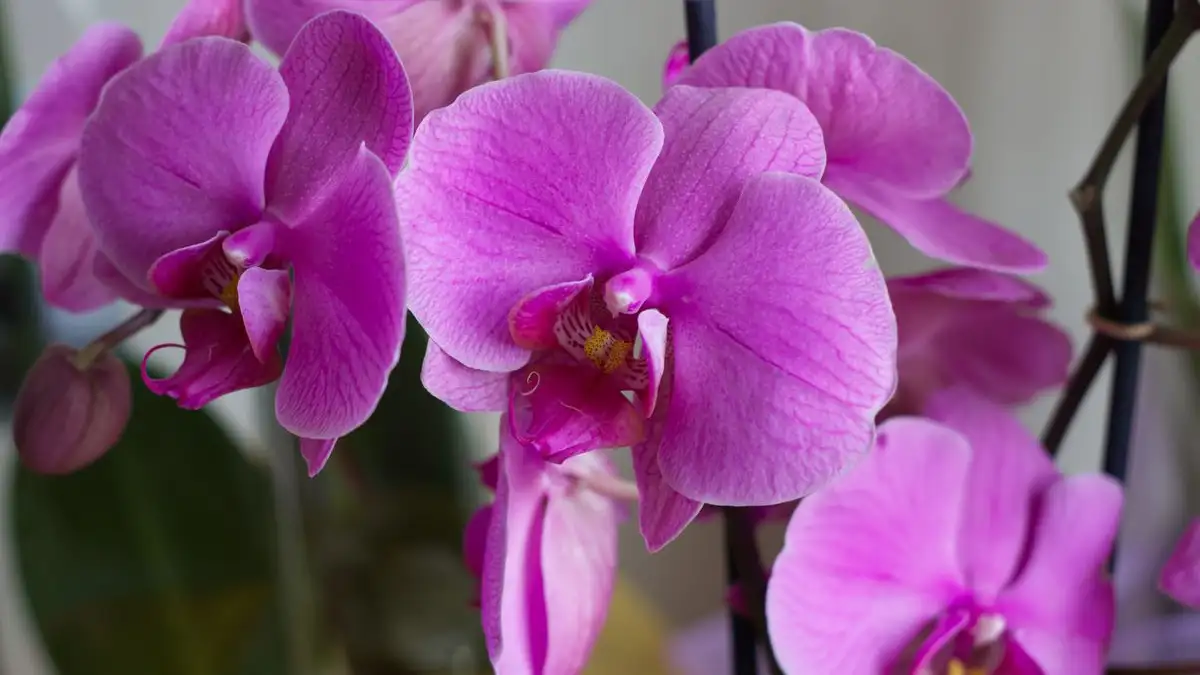
The last time I came close to making that mistake, I was standing at the kitchen sink on a gray morning in March with a Phalaenopsis that had been in the same clear inner pot for three years. The plan was simple: repot it. Three years is past two, two is the rule, and the rule said overdue. I lifted the inner pot out of the ceramic cachepot and tipped it toward the window light, and the plant spent the next thirty seconds telling me I was wrong.
What I saw through the clear plastic was bark still in distinct chunks, tan and reddish-brown, not the dark sludge I had braced for. Silvery roots pressed flat against the wall. At the base of the plant, right where the stem disappeared into the medium, a few pale green nubs with brighter tips. I pinched a piece of bark near the surface and it held. It did not smear. I put my nose to the top of the pot and got nothing back, no sourness, no cellar smell. So I set the inner pot back inside the cachepot and walked away. It flowered two months later, in the same medium, in the same pot.
Three Checks, and Only Three
Years are a proxy for conditions, and conditions are what actually break bark down and fill a pot with roots. So instead of counting, I do three things, in this order.
Bark: does it still hold air?
Bark is the part of the medium doing the work, and it has a service life. In a pot that drains and dries between waterings, it holds its shape for a long time. What ends it is decomposition. Take a chunk from the surface between your fingers. If it resists, if it still has edges and structure, it is still holding air. If it squashes down toward wet coffee grounds, it has finished.
The smell is the other half of the test, and it is the half people skip. Put your face right at the pot surface next to the base of the plant. Healthy medium smells like nothing much, or like damp wood. Spent medium smells sour and musty, like a basement floor. That smell is decomposition running faster than the pot can dry.
This matters because collapsed bark does not drain the way it used to. It holds water in the spaces that used to hold air, and roots sitting in that are roots sitting in a wet blanket. When someone tells me they are watering sparingly and still losing roots, the medium is usually the thing staying wet, not them.
Roots: escape, not just presence
The second check is whether the roots have actually left the container. Not whether you can see roots. Phalaenopsis throw aerial roots constantly, arching up over the medium and hanging in the air, and that is normal behavior at any pot size. The signs that mean something are structural. Roots thick enough to arch over the rim and stay there. A root pushing down through the drainage hole and thickening as it goes. And the one that ends the argument: the plant itself riding up out of the pot, so the crown sits level with or above the rim because the root mass underneath has lifted it. A plant doing any of those is telling you the pot is full.
New root tips: the window
Roots tell you whether to repot. Root tips tell you when. Somewhere at the base of the plant, where the stem disappears into the medium, you will eventually see small silvery-green nubs, and then the growing tips themselves: pale, slightly shiny, sometimes with a green or purplish point. When they show up, the plant is already spending energy on new roots. Repotting then redirects work that is already underway.
Repot outside that window and the plant has to start a root system from scratch, on stored reserves. In late autumn or winter, with light low and growth slowed to a crawl, that rebuilt root system comes out of the plant's savings account. Same job, same pot, much worse terms.
The Cost of Being Early
A root system adapts to its pot. Roots that grew in old, collapsed bark grew into a cycle where the medium dried on a certain schedule and air moved through it in a certain way. Pull that plant out and drop it into fresh bark, and those roots land in a medium that holds more water for longer, inside a pot the roots no longer fill. The plant has to regrow fine roots and root hairs, the whole absorbing surface, while sitting in something wetter than it has ever been used to. That is a recipe for rot in a plant that was healthy a week earlier.
Then comes the misdiagnosis. The roots rot, the plant declines, and the grower decides they are an overwaterer. They cut back on water, the surface bark dries, the inside of the pot stays wet, the rot continues, and the conclusion hardens into a belief that orchids are difficult. They are not. The pot was changed for no reason at the wrong time.
Where the Two-Year Number Came From
I do not think the number is a lie. I think it is a fact about a different plant. Two years is roughly the interval you get in warm, bright, well-fed, year-round growing conditions, the kind where a plant pushes roots and flowers more or less continuously and bark breaks down fast. Move that same plant to a windowsill in a house that gets cold and dry in January and everything slows. Light drops, growth pauses, bark lasts longer, roots grow less. The number was never about your plant. It was about the pace of a plant under different conditions, repeated until it sounded like biology.
When the Calendar Does Get Thrown Out
There are cases where I do not wait for the three checks, and I want to be honest about them. A plant with active rot in the middle of wet, collapsed medium gets repotted now, whatever the season, because that plant is not going to make it to spring. A plant pushing itself up out of the pot cannot wait either. Leave it and the root mass dries and dies at the exposed edges. And if I lift a plant out and find a plug of moisture-holding material still wrapped around the roots at the center of the pot, surrounded by bark that drains freely, that is a problem the surface will never show me, and I deal with it.
Then there is the bloom case. A Phalaenopsis in full flower is usually left alone. Flowers are already spending the plant's energy, and repotting while it blooms stacks a second large demand on top of the first. The exception is medium that is genuinely rotten, in which case the flowers are not going to last anyway. Otherwise I wait for the flowers to drop, then check the bark and roots again.
Checking Without Disturbing Anything
None of this requires guesswork. Every few months, whenever I water and have a minute, I lift the inner pot out of the cachepot and tip it toward the window. If the pot is clear, I read color through the plastic and look at the base for tips. If it is not, I check the rim for escaping roots and the surface for texture and smell. Thirty seconds, no pulling, no poking, no disturbance to the root system. That habit has told me to wait far more often than it has told me to repot, and it has never once told me to repot in November.
What I Do When the Checks Say Yes
Then the timing is the root tips, and the rest is restraint. Same pot if the roots did not actually overflow it. One size up at most, and only if they did. The crown stays above the medium, because burying it is a different way to lose the plant. The bark goes in loose, with a little pressure to settle it, not packed down. Then I leave it alone for a while, because the roots are rebuilding and every disturbance costs something.
That is the whole method. The two-year rule is a fine reminder that orchids do eventually need fresh medium. It is a terrible reason to decide that today is the day. Lift the pot. Look at the bark. Smell it. Check the rim. Check the base for tips. If the medium is still holding air and the roots are still inside the pot, put it back and give it another season. It has one. So do you.
